
The 3 LC Discrepancies That Cost African Buyers $50K+ Per Shipment

You have a confirmed, irrevocable letter of credit from a Kenyan bank. The seller in Shenzhen has presented the documents. The bill of lading matches. The commercial invoice is correct. And the advising bank still flags the presentation — for a discrepancy you didn't see coming.
Between 65% and 75% of documentary credit presentations are flagged for at least one discrepancy on first review, according to ICC Banking Commission data. The figure hasn't moved in a decade. The most common failure points — date mismatches and short-paid insurance — are entirely preventable. Below is exactly how to structure an LC in China-Africa trade so it pays, not fails.
This post covers what an LC actually does, what UCP 600 requires, the difference between confirmed and unconfirmed credits, the seven discrepancies that cause rejection, the realistic transaction timeline, when LC is the wrong instrument, and the LC fraud patterns that have hit China-Africa corridors in recent years.
For the buyer-side compliance framework that runs alongside an LC issuance — supplier verification, documentary discipline, and the verification dossier your bank will request — see our Compliance Verification service and our Buyer Resources. For a worked example on a high-value machinery shipment from China, our machinery verification guide shows how the same documentary discipline applies to the underlying supplier relationship. The supplier side of the same transaction is covered in our machinery factory audit guide, which a seller's bank will sometimes require as a condition of advising.
What a Letter of Credit Actually Does (And Doesn't)
A letter of credit is a written undertaking by a bank — the issuing bank — to pay a specified sum to a seller (the beneficiary) against the presentation of compliant documents. The buyer's bank issues the LC at the buyer's instruction. The seller's bank (the advising bank) reviews the documents when the seller presents them. If the documents comply with the LC terms, the seller's bank pays the seller and then seeks reimbursement from the issuing bank.
The key mechanic is that the LC is document-driven, not shipment-driven. The bank examines the documents — commercial invoice, bill of lading, insurance certificate, packing list, certificates of origin or inspection — not the underlying goods. The bank does not verify whether the goods match the specification, whether the shipment arrived on time, or whether the buyer is satisfied. The bank verifies only that the documents presented comply with the LC terms.
This is the source of both the LC's power and its danger. The power: the seller is paid against documents, often before the goods physically arrive at the destination. The danger: a single discrepancy between the documents and the LC terms gives the issuing bank a clean legal basis to refuse payment, even if the underlying transaction is entirely sound.
Counter to the common advice that LC is "safer than TT," the LC's safety depends entirely on the discipline of the presentation. A letter of credit drafted carelessly, presented against documents that do not precisely match the LC terms, or timed against a shipment deadline that the seller cannot meet is a higher-risk instrument than a simple telegraphic transfer. The LC adds cost (issuing fees, confirming fees, document handling) only when it adds discipline — that is, when both buyer and seller treat the documentary conditions as binding.
UCP 600: The Rulebook That Decides Whether Your LC Pays
UCP 600 is the seventh revision of the Uniform Customs and Practice for Documentary Credits, published by the International Chamber of Commerce in 2007. It superseded UCP 500 and is currently the binding rulebook for documentary credits worldwide. The text is structured in 39 articles covering the credit lifecycle from issuance through presentation, examination, payment, and dispute.
Three articles carry the practical weight for China-Africa trade transactions.
Article 14 governs the standard for examination of documents. It establishes the "compliance" standard: a presentation is complying when it consists of documents that are consistent on their face with the credit, the UCP, and any applicable international standard banking practice. The examination is conducted within five banking days following the day of presentation. The five-day window is a maximum, not a target — banks may examine faster.
Article 16 governs refusal. When a bank decides that a presentation does not comply, it must give a single notice to that effect, stating each discrepancy for which the bank refuses to pay. The notice must be sent no later than the close of the fifth banking day following the day of presentation. A bank that fails to follow the Article 16 procedure is precluded from claiming that the presentation does not comply — this is the buyer's protection against informal rejection.
Article 18 governs the commercial invoice. The description of goods on the invoice must correspond with the description in the credit. This is a stricter standard than the "no conflict" rule applied to other documents under Article 14, and it is the single most common refusal trigger. Abbreviations, marketing additions, model numbers, or any rewording of the credit's goods description breach the correspondence requirement.
UCP 600 also addresses insurance. Article 28 establishes that where a credit requires insurance, the insurance document must be effective no later than the date of shipment, cover at least 110% of the CIF or CIP value, and be in the currency of the credit. A common discrepancy is an insurance document that covers only 100% of the value, or that names a coverage currency different from the credit.
The buyer and the seller should both read UCP 600 before the LC is issued. Most refusals are preventable through drafting discipline, not through luck. The shipping line, the insurance broker, and the inspection agency should all be working from the same set of documentary requirements — preferably copied directly from the LC text — to avoid last-minute mismatches.
Confirmed vs Unconfirmed LC: When the Extra Cost Is Worth It
An unconfirmed LC carries only the issuing bank's payment undertaking. The seller is paid if the documents comply and the issuing bank honours the credit. If the issuing bank refuses — for any reason, including political risk, sanctions, or insolvency — the seller is exposed.
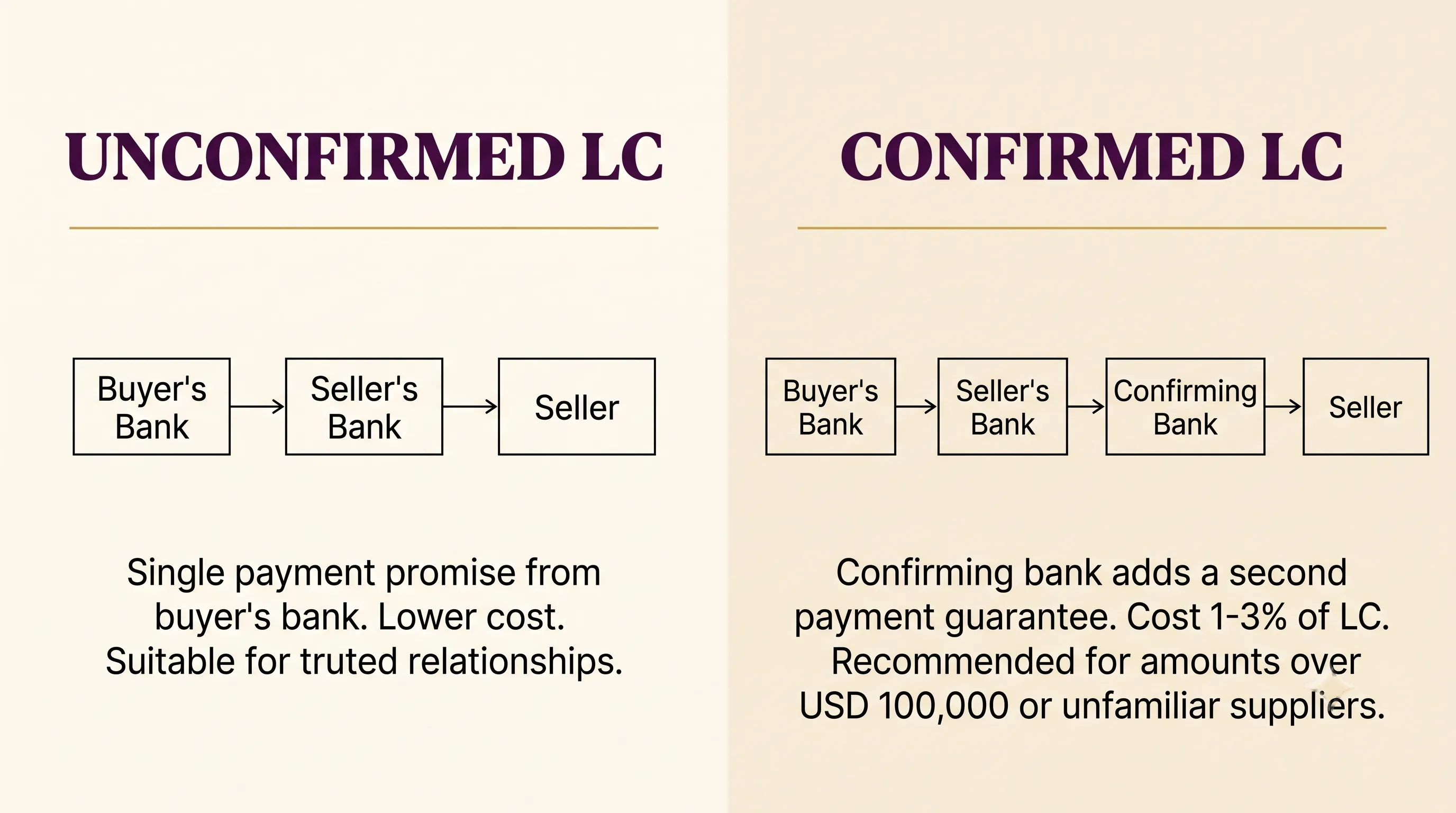
A confirmed LC adds a second bank's payment undertaking. The confirming bank — typically a major international bank with operations in the seller's country — adds its own irrevocable commitment to pay against compliant presentation. If the issuing bank refuses, the confirming bank still pays. The seller is paid by the confirming bank regardless of what happens at the issuing bank.
The cost of confirmation is 1-3% of the LC value, charged by the confirming bank and typically passed to the seller in the form of a reduced net invoice. For high-volume or low-margin transactions, the cost is material. For higher-value transactions with unfamiliar suppliers, the cost is a fraction of the value of an unrecoverable shipment.
The threshold for using a confirmed LC is straightforward. Use a confirmed LC when any of the following conditions apply: the issuing bank is in a jurisdiction with material political or economic risk, the seller is unfamiliar and has no track record with the buyer, the LC value exceeds USD 100,000, or the goods are custom-built or irreplaceable. For repeat transactions with established suppliers where the issuing bank is a major international bank in a stable jurisdiction, an unconfirmed LC is typically sufficient.
Counter to the common advice that "always confirm," the confirmation premium is not free, and it does not eliminate the documentary-compliance risk. A confirmed LC still rejects on discrepancies. Confirmation protects against issuing-bank risk, not against presentation risk.
The Seven Discrepancies That Cause LC Rejection
Industry analysis from trade finance publications and the ICC Banking Commission consistently identifies the same seven recurring discrepancies. Each is preventable.
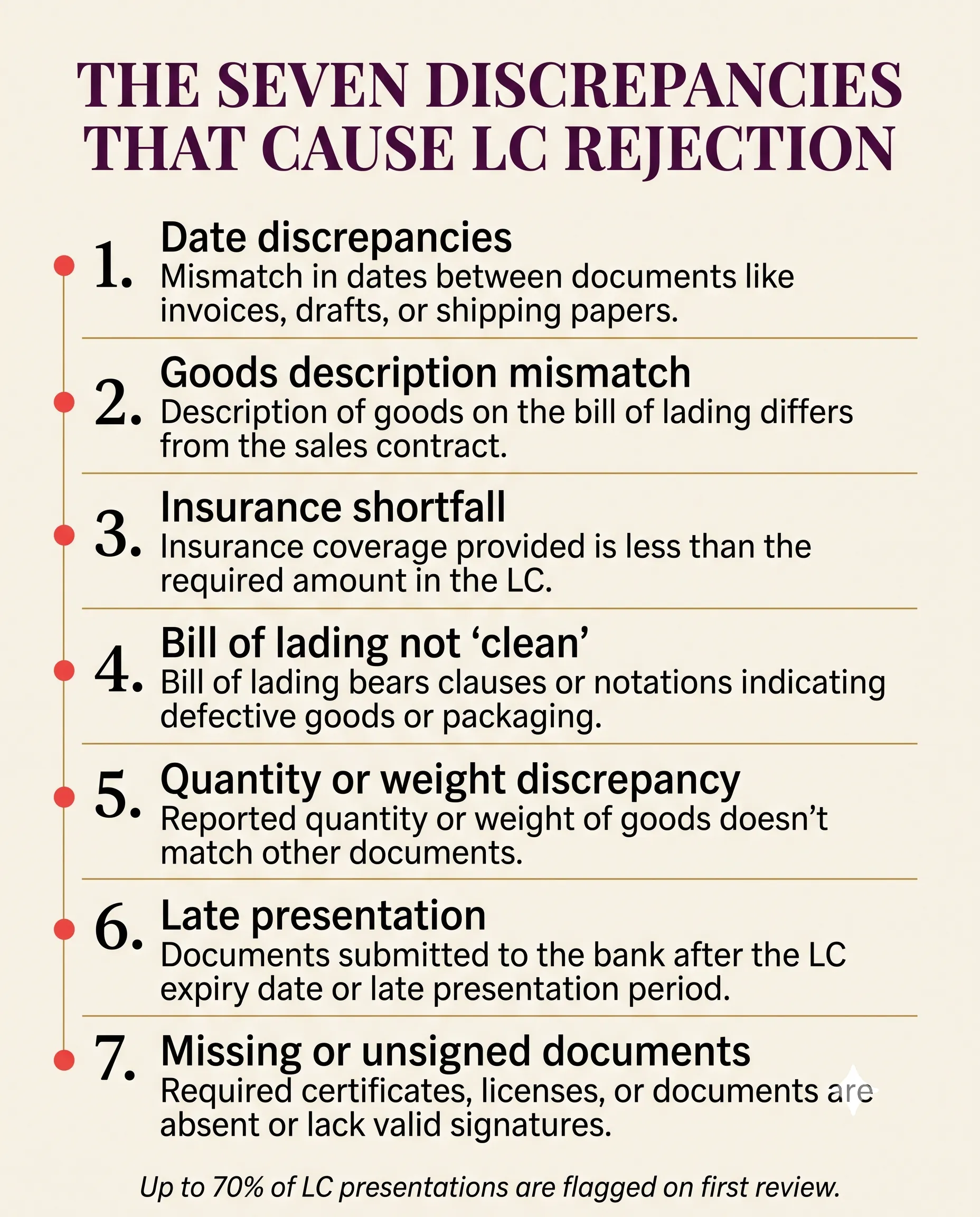
| # | Discrepancy | What it looks like | Prevention |
|---|---|---|---|
| 1 | Goods description mismatch | Invoice wording differs from the credit — shortened, abbreviated, or with added marketing terms | Mirror the credit's goods description word-for-word on the invoice. Use the credit text as the invoice template. |
| 2 | Date discrepancy | Bill of lading dated after the latest shipment date; presentation after the 21-day limit under Article 14(c) | Run deadlines as a closing calendar. Build buffer for weekends, port delays, third-party document issuance. |
| 3 | Insurance document shortfall | Coverage below 110% of CIF/CIP value; wrong risks; cover date later than shipment date; wrong currency | Hand the broker the exact insurance clause from the LC. Validate coverage math against the invoice value before shipment. |
| 4 | Transport document issues | Wrong consignee or notify party; missing endorsements; claused bill of lading; missing on-board notation; incorrect ports | Confirm the exact transport-document format the credit requires (UCP 600 Articles 19-25). Instruct the forwarder in writing before the goods move. |
| 5 | Quantity or weight mismatch | Different units across documents; rounding differences; net vs gross weight conflict; totals that do not reconcile | Standardise units at the drafting stage. Reconcile every total across invoice, packing list, and certificates before presentation. |
| 6 | Certificate requirements not met | Missing fields; wrong issuer identity; unauthorised signatory; wording that departs from the credit | Use pre-approved templates. Confirm issuer identity and signing authority before shipment, not after the certificate is issued. |
| 7 | Late or missing presentation | Documents presented after the 21-day window from shipment, or after the LC expiry | Sequence the dates logically. Build a master presentation calendar from the LC terms. Allow a 5-day buffer before the LC expiry. |
Each of these discrepancies is a clerical or coordination failure, not a substantive issue with the underlying transaction. None of them requires bad faith. Most of them require nothing more than reading the LC carefully and copying the conditions into each downstream document.
The single most effective prevention technique is the master data sheet. Build one worksheet that captures every data field required by the LC — supplier name, address, registration number, goods description, unit price, total value, currency, shipment date, expiry date, port of loading, port of discharge, insurance clause. Copy the same fields into the invoice, the packing list, the bill of lading instructions, the insurance instructions, and every certificate. Never retype a field from memory.
LC Presentation Discipline on the Supplier Side
The seller's bank examines the documents before sending them to the issuing bank. A presentation that fails the advising bank's pre-check is corrected before transmission. A presentation that fails the issuing bank's check is refused under Article 16.
The standard seller-side discipline has four steps. The first is document preparation against a checklist compiled from the LC text. The second is internal review by a second person — the document checker who did not prepare the documents. The third is pre-check by the advising bank, which most major Chinese banks offer as a free or low-cost service for LC presentations. The fourth is courier timing — booking the courier for two to three banking days before the LC expiry to allow for transit time and any Article 16 notice that needs to be addressed.
Counter to the common advice that the seller's bank is "on the seller's side," the advising bank is a neutral examiner. Its job is to identify discrepancies before the issuing bank does. A seller who skips the pre-check step is paying for an Article 16 refusal in the form of a missed shipment, a frozen LC, and a damaged commercial relationship with the buyer.
For African importers structuring an LC, the buyer-side discipline is equally important. The LC must be drafted precisely enough that the seller can comply. A vague or contradictory LC is a recipe for refusal — even if the seller is willing and able to perform, the documents cannot meet a specification that does not exist.
Timeframes, Costs, and the Realistic Transaction Lifecycle
The realistic timeline from LC issuance to payment is six to twelve weeks for a sight LC on a standard shipment. The breakdown is approximately: one to two weeks for LC issuance through the buyer's bank and advising by the seller's bank; four to eight weeks for production and shipment; one to two weeks for document preparation and presentation; five to seven banking days for the issuing bank's examination under Article 14(f). Deferred payment LCs add the deferred period — typically 30 to 90 days — between acceptance and payment.
The cost structure of an LC has three components. The issuing fee is charged by the buyer's bank, typically 0.125-0.25% of the LC value per quarter or part thereof, with a minimum fee. The advising fee is charged by the seller's bank, typically a flat fee of USD 100-300. The confirmation fee, if applicable, is charged by the confirming bank at 1-3% of the LC value per annum, prorated to the LC tenor.
For a USD 200,000 LC with confirmation, the total issuing, advising, and confirmation cost is approximately USD 4,500-7,500 in bank fees. This is the price of the documentary discipline the LC imposes. It is materially cheaper than the cost of an unrecoverable wire to a fraudulent supplier, but it is more expensive than a telegraphic transfer with no documentary protection.
African banks typically charge more than the international rate for LC issuance. Local banking in Kenya, Tanzania, and Ghana runs at 2-4% per LC transaction, an order of magnitude higher than the 0.25-0.5% rates common in advanced markets. This pricing reflects the underlying country-risk premium and the correspondent banking costs for cross-border settlements.
When an LC Is the Wrong Instrument
The letter of credit is the right instrument for some transactions and the wrong instrument for others. Three conditions suggest the LC is the wrong choice.
The first is a low-value, repeat transaction with an established supplier. The fixed cost of LC issuance is amortised over the LC value. For transactions below USD 50,000, the LC issuing fee may exceed 1% of the value. A 30/70 telegraphic transfer structure with a trusted supplier is faster, cheaper, and operationally simpler.
The second is a transaction where the documentary conditions cannot be precisely specified. If the goods are not standardised — bespoke manufacturing, custom specifications, complex installation — the documents cannot be drafted precisely enough for compliance. The LC then becomes a trap for both parties.
The third is a transaction with a buyer or seller new to documentary credits. The first LC is a learning experience, and learning experiences fail. For first-time LC users, a smaller test transaction with a confirmed LC from a major international bank is the safer path.
For these three conditions, a telegraphic transfer with staged payment (30/30/40, or 30/70) and a written purchase agreement is the better instrument. The buyer accepts higher transactional risk in exchange for lower cost and operational simplicity.
LC Fraud Patterns and How to Avoid Them
Three LC fraud patterns have hit China-Africa corridors in recent years. Each is preventable.
The first is the fictitious LC. The buyer receives an LC that appears to be issued by a major international bank, often by email or SWIFT terminal display. On examination, the LC is fabricated — either the issuing bank does not exist, or the issuing bank has no record of the LC. The seller's bank typically catches this during advising, but the fraud works when the seller skips advising and ships against the apparent LC. The prevention is simple: every LC must be advised through the seller's bank before shipment.
The second is the LC issued on behalf of an undisclosed principal. The LC names a beneficiary that is not the actual seller. The actual seller ships the goods, but the documents are presented in the name of the named beneficiary. The fraud is exposed when the goods arrive at destination and the issuing bank or the named beneficiary refuses to release them. The prevention is for the buyer to verify, through independent channels, that the named beneficiary is the actual exporter.
The third is the LC amendment trap. The buyer amends the LC mid-transaction — typically extending the shipment date or increasing the value — in exchange for an additional deposit from the seller. The amendment carries fees, the additional deposit is unrecoverable, and the underlying transaction is now over-funded. The prevention is to refuse amendments that change the fundamental commercial terms after the original LC is issued.
Counter to the common advice that LC fraud is rare, the fraud rate in documentary credits is correlated with the unfamiliarity of the parties. Established buyer-seller relationships using standard LCs at major international banks experience negligible fraud. New relationships, unusual jurisdictions, and unfamiliar banks are where the fraud concentrates.
A Note on What We Do
Rumali Supreme does not buy, sell, or take title to commodities — including gold, minerals, machinery, apparel, building materials, vehicles, and consumer goods. We facilitate cross-border transactions between buyers and vetted suppliers, charging a fixed facilitation fee for verification-only engagements and a percentage on successful transactions when our role extends to sourcing, payment coordination, or shipment oversight. Our reports, checklists, and blog content describe facilitation methodology only; they are not legal, tax, or financial advice, and should be read alongside current regulations in the jurisdictions involved.
Frequently Asked Questions
How does a letter of credit work in China-Africa trade?
The buyer's bank (the issuing bank) issues an LC in favour of the seller (the beneficiary), promising to pay against presentation of documents that comply with the LC terms. The seller's bank (the advising bank) reviews the documents when presented. If the documents comply, the seller's bank pays the seller and seeks reimbursement from the issuing bank. The transaction is document-driven — the bank examines the documents, not the goods. The buyer pays the issuing bank on the LC maturity date. Total realistic timeline: 6-12 weeks for a sight LC on a standard shipment.
What are the most common LC discrepancies that cause rejection?
The seven most common discrepancies are: (1) goods description mismatch between the invoice and the credit, which is the single largest refusal trigger under UCP 600 Article 18; (2) date discrepancies including shipment after the latest shipment date and presentation after the 21-day window under Article 14(c); (3) insurance document shortfall, most often coverage below 110% of CIF or CIP value; (4) transport document issues including wrong consignee, missing endorsements, or missing on-board notation; (5) quantity or weight mismatch across documents; (6) certificate requirements not met, including missing fields or unauthorised signatories; (7) late or missing presentation, including documents presented after the LC expiry.
Should I use a confirmed or unconfirmed letter of credit?
Use a confirmed LC when any of the following apply: the issuing bank is in a jurisdiction with material political or economic risk; the seller is unfamiliar with no track record; the LC value exceeds USD 100,000; or the goods are custom-built or irreplaceable. The confirming bank adds its own irrevocable payment commitment, so the seller is paid regardless of any refusal at the issuing bank. The cost is 1-3% of the LC value per annum, charged by the confirming bank. For repeat transactions with established suppliers and a major international issuing bank, an unconfirmed LC is typically sufficient.
What is UCP 600 and why does it matter?
UCP 600 is the International Chamber of Commerce's Uniform Customs and Practice for Documentary Credits, 2007 Revision, ICC Publication No. 600. It is the binding rulebook for documentary credits worldwide. Both the issuing and advising banks apply UCP 600 to any LC that expressly indicates it is subject to UCP, which is the default. UCP 600 superseded UCP 500 in 2007. The text is structured in 39 articles covering the credit lifecycle from issuance through presentation, examination, payment, and dispute. The most cited articles in practice are Article 14 (examination standard), Article 16 (refusal procedure), Article 18 (commercial invoice), and Article 28 (insurance).
How long does an LC transaction take from issuance to payment?
Realistic total timeline: 1-2 weeks for LC issuance and advising, 4-8 weeks for production and shipment, 1-2 weeks for document preparation and presentation, and 5-7 banking days for the issuing bank's examination under Article 14(f). Total: 6-12 weeks for a sight LC. Deferred payment LCs add the deferred period — typically 30 to 90 days — between acceptance and payment. The issuing bank's 5-day examination window is a maximum under Article 14(f); banks may examine faster, but cannot take longer without precluding refusal under Article 16.
Can a letter of credit be cancelled by the buyer after issuance?
Yes, in most cases. The buyer can request cancellation through the issuing bank, but the beneficiary (the seller) must consent. An irrevocable LC — the default for trade transactions — cannot be cancelled or amended without the agreement of the issuing bank, the confirming bank (if any), and the beneficiary. Revocable LCs exist in theory but are not recommended for trade transactions because the issuing bank can amend or cancel them unilaterally without notice to the beneficiary. For practical purposes, treat all LCs as irrevocable and plan accordingly.
Related Articles

Why 60% of African Importers Miss Out on AfCFTA Duty Savings (and How to Claim Yours)
A single 60% African-content threshold decides whether your goods cross the border duty-free or get hit with full MFN duty. How to document your supply chain, qualify, and claim the saving before your next shipment.

What 73% of Canton Fair Buyers Miss in the First 48 Hours (2026 Checklist)
Autumn 2026 Canton Fair runs 15 Oct–4 Nov. Most orders placed on first contact fail within 90 days. Ten pre-flight checks — plus three red flags that should stop any wire before you fly home.

The 5-Minute Trick That Catches 9 Out of 10 Fraudulent Freight Forwarders
A Mombasa buyer lost $38,000 to a fake freight forwarder in 96 hours. Don't be next. Seven verification checks — licensing, bonding, references — and the one red flag that ends the deal.

The 4 Decisions Every Diaspora Buyer Gets Wrong on Their First China Order
Over $50B in remittances flows to Africa annually — but first-time diaspora importers lose their capital on bad suppliers, wrong specs, and unverified freight. Five steps to source from China without becoming a statistic.
Don't Learn About a Scam After You've Wired the Money
One short email per week. Real trade risk intelligence — supplier red flags, regulatory changes, and verification checklists. Before the wire, not after the loss.