
What 73% of Canton Fair Buyers Miss in the First 48 Hours (2026 Checklist)
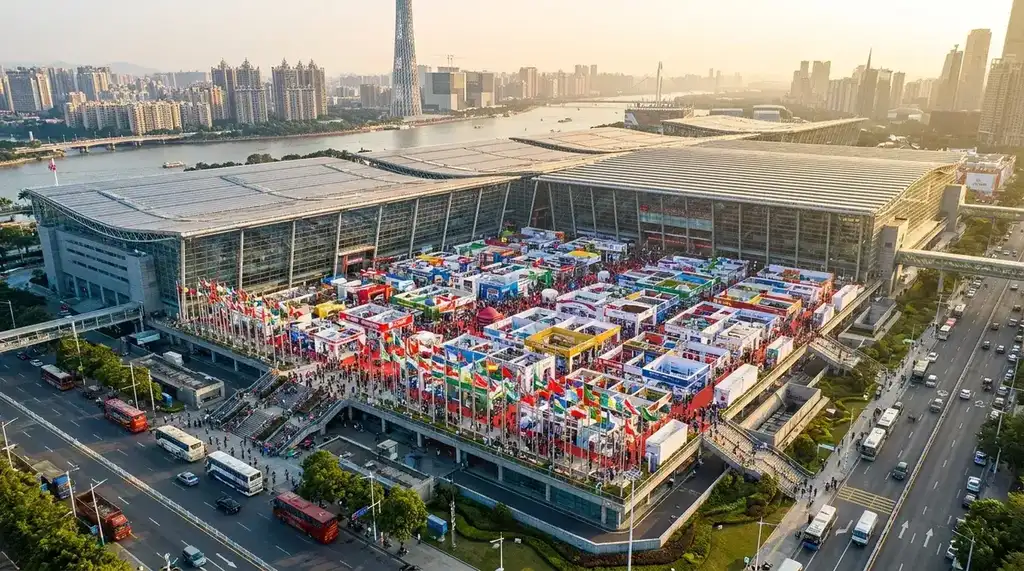
A Kenyan importer attended Canton Fair Phase 2 in October 2025. They spent three days walking halls, collected 40 business cards, and placed a USD 52,000 trial order for ceramic tiles with a Guangzhou exhibitor who had a polished booth, two English-speaking sales reps, and a catalogue that matched the buyer's market exactly. They wired a 30% deposit from their Nairobi hotel room on the last day of the Fair. The production sample arrived six weeks later. The tile thickness was 1.5mm below spec, the glaze was inconsistent, and the colour didn't match the booth sample. The supplier offered a 5% discount on the next order. There was no next order.
Canton Fair is a discovery event, not a verification event. Buyers who arrive expecting to confirm a supplier at the booth leave with catalogues, WeChat contacts, and prices that don't agree with each other. The operational goal isn't "find the supplier" — it's "find three to five candidates worth deeper work" before any deposit leaves your account.
The autumn 2026 Canton Fair runs 15 October to 4 November across three phases. If you're flying out, the planning window is eight to twelve weeks — and the verification should already be running before you board the plane.
This checklist is structured around the full buying cycle: pre-fair research (two weeks before flying), in-booth checks (the ten questions to ask every exhibitor), three red flags that should end the conversation, sample handling discipline, the post-fair verification window (the two weeks after landing), and the payment structure that protects the wire. The framework applies whether you are attending Phase 2 (consumer goods, gifts, home decoration) or Phase 3 (textiles, garments, office supplies, food, medical products).
For the underlying supplier verification framework that applies whether you meet a supplier at the Fair or source online, see our China sourcing verification guide. For buyers attending the Fair with a custom research brief in hand — a defined product specification, a target factory profile, or a list of pre-qualified exhibitors — our Custom Research engagement covers the pre-fair preparation in detail. Buyers sourcing Phase 3 textiles and garments should also read our apparel supplier verification guide, which applies the same 10-check framework to garment factories specifically.
Why Most Canton Fair Orders Fail After the Fair
The Canton Fair's official autumn 2026 programme lists roughly 25,000 booths across the three phases, with over 10,000 participating enterprises. Of those enterprises, a meaningful share are trading companies posing as factories, distributors handling product lines they did not manufacture, or front operations for offshore entities that disappear after the deposit clears.
The Fair itself is a legitimate trade venue — verified exhibitors, organised halls, official directories. The risk is not in the venue but in the supplier selection process. Buyers who treat the Fair as a sourcing shortcut — meet at the booth, place an order, wire a deposit, fly home — discover the failure mode only when the production sample arrives six weeks later and bears no resemblance to the booth sample.
The failure rate is not formally published by the Fair organisers, but trade-press coverage and buyer-side verification services consistently describe the same pattern: a high share of orders placed on first-contact without verification fail within 90 days of placement. The reasons cluster into three categories: the supplier was a trading company that could not control production quality, the supplier substituted lower-grade materials between sample and production, or the supplier accepted the deposit and then renegotiated the price after the buyer's return flight.
The fix is procedural. Treat the Fair as a discovery channel. Use the booth meetings to narrow a long list to three to five candidates. Run full verification on those candidates before any wire is sent. The verification includes licence checks, export record verification, factory video walk-throughs, and independent sample evaluation. The procedure mirrors what a buyer should run on any Chinese supplier, with the Fair as the catalyst rather than the conclusion.
Pre-Fair Research: The Two Weeks Before You Fly
The two weeks before travelling are the most under-used slot in the buyer's calendar. Most buyers arrive at the Fair with a shortlist of categories rather than a shortlist of suppliers. The reverse sequence is faster and cheaper: identify 15-20 candidate exhibitors before flying, pre-screen each against the National Enterprise Credit Information Publicity System (NECIPS) for licence validity and registered business scope, and rank them by export history.
Three pre-fair checks deserve attention. The first is exhibitor directory matching. The Canton Fair International Pavilion publishes exhibitor listings by hall and booth number. A supplier whose booth listing matches their registered Chinese name and product category is a higher-confidence starting point than one whose booth signage carries a slightly different name or whose product category does not match their licence scope.
The second is Qichacha or Tianyancha cross-reference. These commercial registry platforms surface the company's business scope (经营范围), registered capital, legal representative, and any administrative penalties. A factory registration includes "production" or "manufacturing" terms specific to the product category; a trading company registration lists "trade," "wholesale," or "import/export." Screenshot the business scope, run it through Google Translate, and the company type is clear in under a minute.
The third is export-record verification through China Customs. A supplier claiming five years of exports to East Africa should produce export records that confirm it. A supplier claiming ten years of exports to Europe but with no verifiable record on the Customs platform is misrepresenting its history. This check is harder to run without a contact at China Customs, but it is the single highest-yield verification step and is worth engaging a facilitator for if the order size justifies it.
Pre-fair research should produce a ranked shortlist of 5-8 suppliers per product category before the buyer boards the plane. The Fair itself becomes a confirmation exercise — meeting the people behind the registration, walking the booth, testing responsiveness — rather than a discovery exercise.
At the Fair: Ten Checks to Run on Every Booth
The ten checks below are sequenced for speed. A buyer who runs all ten on every priority booth will spend roughly 12-15 minutes per meeting. That pace allows 30-40 priority meetings across a five-day Fair.
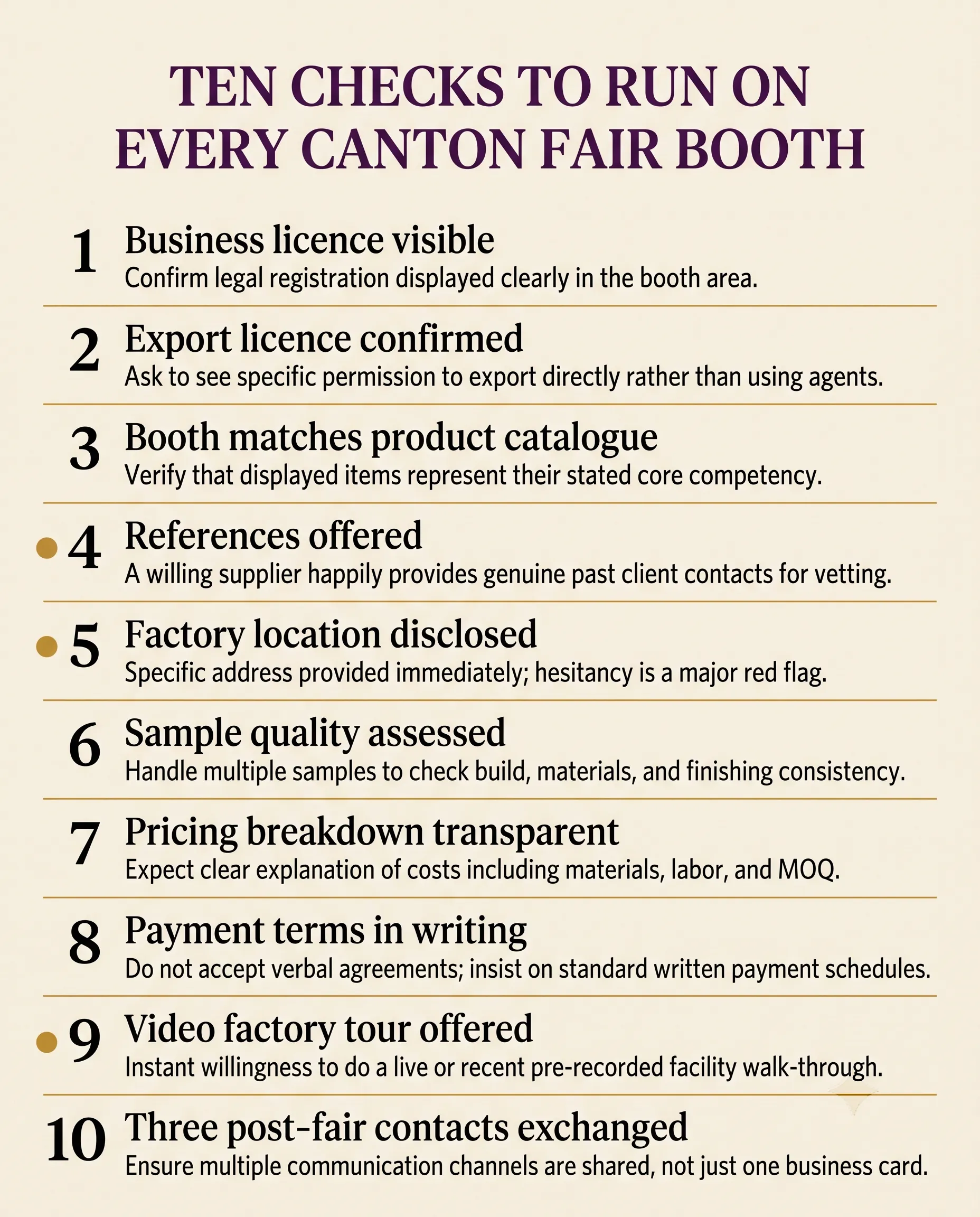
| # | Check | What to look for |
|---|---|---|
| 1 | Booth signage | Company name in English and Simplified Chinese, booth number matching the official directory |
| 2 | Business card | Legal Chinese entity name, 18-digit Unified Social Credit Code, direct landline, mobile number |
| 3 | Product range | Live product samples matching the booth listing, not catalogue-only displays |
| 4 | Production location | Asked directly: "Where is production?" — trading companies deflect, factories answer |
| 5 | Export history | Specific countries, specific years, ideally with bill of lading references |
| 6 | Business licence | Photo of the printed licence on the wall or shown on request |
| 7 | Certifications | Specific cert numbers visible, not generic claims of "ISO certified" |
| 8 | Sample pricing | Unit price, MOQ, sample lead time, sample cost refund policy |
| 9 | Production capacity | Monthly output figure for the relevant product line |
| 10 | Communication quality | Email response within 24 hours, English fluency, willingness to do video call |
The fifth and sixth checks are the highest-yield. A factory that volunteers its full Chinese name, its 18-digit Unified Social Credit Code, and its production address is operating in good faith. A trading company that hesitates, deflects, or offers only an "office address" is signalling the structure of the operation.
Take photographs of every business card laid flat on a neutral surface, every business licence, every certificate, and every booth signage. The photographs become the evidence base for the post-fair verification window. Without them, the verification cannot proceed.
The Three Red Flags That End the Conversation
Three signals at the booth are disqualifying.
The first is refusal to provide the business licence or the Unified Social Credit Code. A legitimate exhibitor at the Canton Fair has both readily available — printed on the wall, in their digital records, or on the official Canton Fair badge. A request to "send it later" or "we don't carry it" is a signal that the licence either does not exist or belongs to a different entity than the one at the booth.
The second is a quote significantly below market. If three other booths quote USD 4.20-4.80 per unit for a comparable product and the fourth quotes USD 3.10, the fourth quote is priced below cost. The only ways to honour it are to substitute materials, short the quantity, or accept the deposit and renegotiate after the buyer is home. None of those outcomes serves the buyer.
The third is pressure to wire a deposit before the buyer leaves Guangzhou. The post-fair verification window exists for a reason: it gives the buyer time to run independent checks before any capital is committed. A supplier who insists on same-day wire transfer is removing that window deliberately.
Counter to the common advice that any Canton Fair contact is worth pursuing, the higher-value move is to leave the booth. The Fair runs for five days; the next phase runs twice a year. The opportunity cost of skipping a poor exhibitor is minimal compared to the cost of wiring a deposit to a poor exhibitor.
Sample Handling and What It Actually Tells You
Sample handling predicts production behaviour. A supplier that takes two weeks to deliver a sample, sends the wrong SKU, or refuses to ship a paid sample is signalling exactly the same behaviour it will exhibit on the production run.
The standard sample protocol for a Canton Fair follow-up is straightforward. Request a paid sample — USD 30-200 plus courier — for each shortlisted supplier. Specify the SKU, the specification, and the packaging. Pay for the sample by wire or PayPal only after confirming the company name and bank account. Document the sample cost refund policy: many Chinese suppliers refund the sample cost against the first production order above a specified MOQ.
Evaluate samples against four criteria. The first is material consistency: does the sample match the booth display in weight, finish, and colour? The second is dimensional accuracy: does the sample match the agreed specification to within stated tolerances? The third is packaging suitability: is the sample packed for export, with appropriate carton strength and moisture protection? The fourth is communication discipline: did the supplier meet the agreed sample lead time, respond to specification queries, and confirm the courier tracking number?
For high-value orders, commission independent laboratory testing on the sample. A textile buyer should test for fibre composition and colour fastness. A machinery buyer should test for material grade against the specification. A building materials buyer should test for base metal thickness and coating mass. The test costs USD 200-500 per sample. The cost of a full container of non-compliant goods is orders of magnitude higher.
Post-Fair Verification: The Two Weeks After You Land
The two weeks after returning from the Fair are the verification window. They are also the window when most buyers drop the ball — they arrive home tired, the Fair contacts fade, and the deposit wires go out within days without independent verification.
The post-fair procedure has five stages. The first is consolidation: collect all business cards, photographs, sample shipping details, and meeting notes into a single workbook. The second is shortlist reduction: cut the candidate list to the top 3-5 per product category based on booth performance and sample viability. The third is structured follow-up: send each shortlisted supplier a standardised RFQ with product specification, target MOQ, target landed cost, required Incoterm, and payment terms preference. The fourth is sample order: place paid samples with the top 3 suppliers per category. The fifth is independent verification: run NECIPS licence check, export record check, and video factory tour on each shortlisted supplier before any wire is sent.
The verification checks themselves mirror the pre-fair checks but with sharper focus. A supplier that performed well at the booth but whose NECIPS record shows administrative penalties, dissolved status, or a different registered scope than claimed is not safe to wire. A supplier whose video factory tour shows a trading office rather than a production floor is not a manufacturer regardless of what they claimed at the booth.
The International Chamber of Commerce's Incoterms 2020 rules are the standard reference for the trade terms specified in the RFQ. FOB (Free on Board) at the Chinese port is the most common starting point for African-bound cargo; CIF (Cost, Insurance, Freight) to Mombasa or Dar es Salaam is common for buyers who want a single delivered price. The Incoterm chosen shapes which party books the carrier, which party takes the insurance, and where the risk transfers — details that matter at the moment of wire.
Payment Structure for Post-Fair Orders
The standard payment structure for a post-fair first order is 30% deposit on confirmed purchase order, 70% balance against a clean pre-shipment inspection report and bill of lading. This structure protects the deposit against the most common failure modes: production abandonment, quality failure, and supplier disappearance.
For orders above USD 100,000, an irrevocable letter of credit issued by the buyer's bank in favour of the Chinese supplier provides additional protection. The LC is governed by ICC Publication 600 (UCP 600), the standard rules for documentary credits. The cost is 1-3% of the LC value, payable to the issuing bank. For unfamiliar suppliers, the LC cost is materially lower than the cost of an unrecoverable deposit.
For orders below USD 20,000, the 30/70 structure is sufficient. Document the payment terms in a written purchase agreement that names: the product specification, the agreed price, the Incoterm, the inspection regime, the shipment deadline, and the dispute resolution mechanism. The written agreement is the documentary basis for any subsequent recovery action.
Counter to the common advice that 100% prepayment secures better pricing, the inverse is closer to the truth. A supplier willing to accept 100% prepayment is signalling either financial distress (they need the cash flow) or fraudulent intent. A supplier that accepts the standard 30/70 structure is signalling operational confidence — they expect to be paid on delivery because they expect to deliver.
When to Skip the Fair Entirely and Source Online
The Fair is not the only route into Chinese supply. For buyers sourcing lower-volume, lower-complexity products, online platforms with established trade assurance programmes offer comparable access without the cost of travel.
The threshold for skipping the Fair is roughly: order value below USD 50,000 per product category, no need for physical product inspection, and an existing shortlist of online suppliers with verifiable licences and references. Under those conditions, the cost of attending the Fair — flights, accommodation, registration, opportunity cost of seven working days — exceeds the verification benefit.
The Fair becomes essential when the order value is high enough that the cost of a wrong supplier exceeds the cost of travel, when physical product inspection is required, or when the buyer is new to a product category and needs the breadth of options the Fair provides. For those conditions, the procedural discipline outlined above is the only safeguard against the failure modes documented across buyer-side coverage.
For the documentary discipline that protects the post-Fair first order — independent sample evaluation, pre-shipment inspection scheduling, and the verification dossier the buyer should compile before any wire — see our Buyer Resources and our machinery verification guide for a worked example on a high-value machinery shipment.
A Note on What We Do
Rumali Supreme does not buy, sell, or take title to commodities — including gold, minerals, machinery, apparel, building materials, vehicles, and consumer goods. We facilitate cross-border transactions between buyers and vetted suppliers, charging a fixed facilitation fee for verification-only engagements and a percentage on successful transactions when our role extends to sourcing, payment coordination, or shipment oversight. Our reports, checklists, and blog content describe facilitation methodology only; they are not legal, tax, or financial advice, and should be read alongside current regulations in the jurisdictions involved.
Frequently Asked Questions
How do I verify a Canton Fair supplier after the fair?
Run the same verification you would run on any Chinese supplier, with sharper focus on the post-fair window. Verify the business licence via NECIPS using the 18-digit Unified Social Credit Code captured at the booth. Confirm export records through China Customs. Conduct a video walk-through of the factory — not the sales office — and request three references from previous international buyers. A supplier that performed well at the booth but fails any of these checks is not safe to wire. The post-fair verification window is two weeks; use it.
What should I confirm before wiring a deposit to a Canton Fair contact?
Five minimum checks. First, the NECIPS licence is verified and matches the booth signage. Second, a video factory tour has been completed showing the actual production floor, not a sales office. Third, three references from previous international buyers have been contacted directly and confirmed delivery performance. Fourth, the export licence is confirmed via China Customs, with records consistent with the claimed export history. Fifth, an independent sample has been evaluated against the specification. Any one of these five failing means no wire.
Which Canton Fair suppliers should I avoid?
Disqualifying behaviours are: refusing to provide the business licence or Unified Social Credit Code, quoting prices 15-25% below competing booths without a clear justification, pressuring for same-day wire transfer, having a business scope on the licence that does not match the products sold (typically "trade" rather than "manufacturing"), and being unable to provide three references reachable by direct phone call. A stack of red flags means the Fair gave you leads, not a qualified supplier.
Is it safe to source from Canton Fair?
Yes, with the same due diligence applied to any Chinese supplier. The Fair itself is a legitimate trade venue with verified exhibitors and an official directory. The risk is in supplier selection, not in the Fair. Use the Fair as a discovery channel to narrow a long list to three to five candidates per product category, then apply full verification before any wire is sent. The Fair does not replace verification; it compresses the discovery timeline.
What is the difference between Canton Fair Phase 1, 2, and 3?
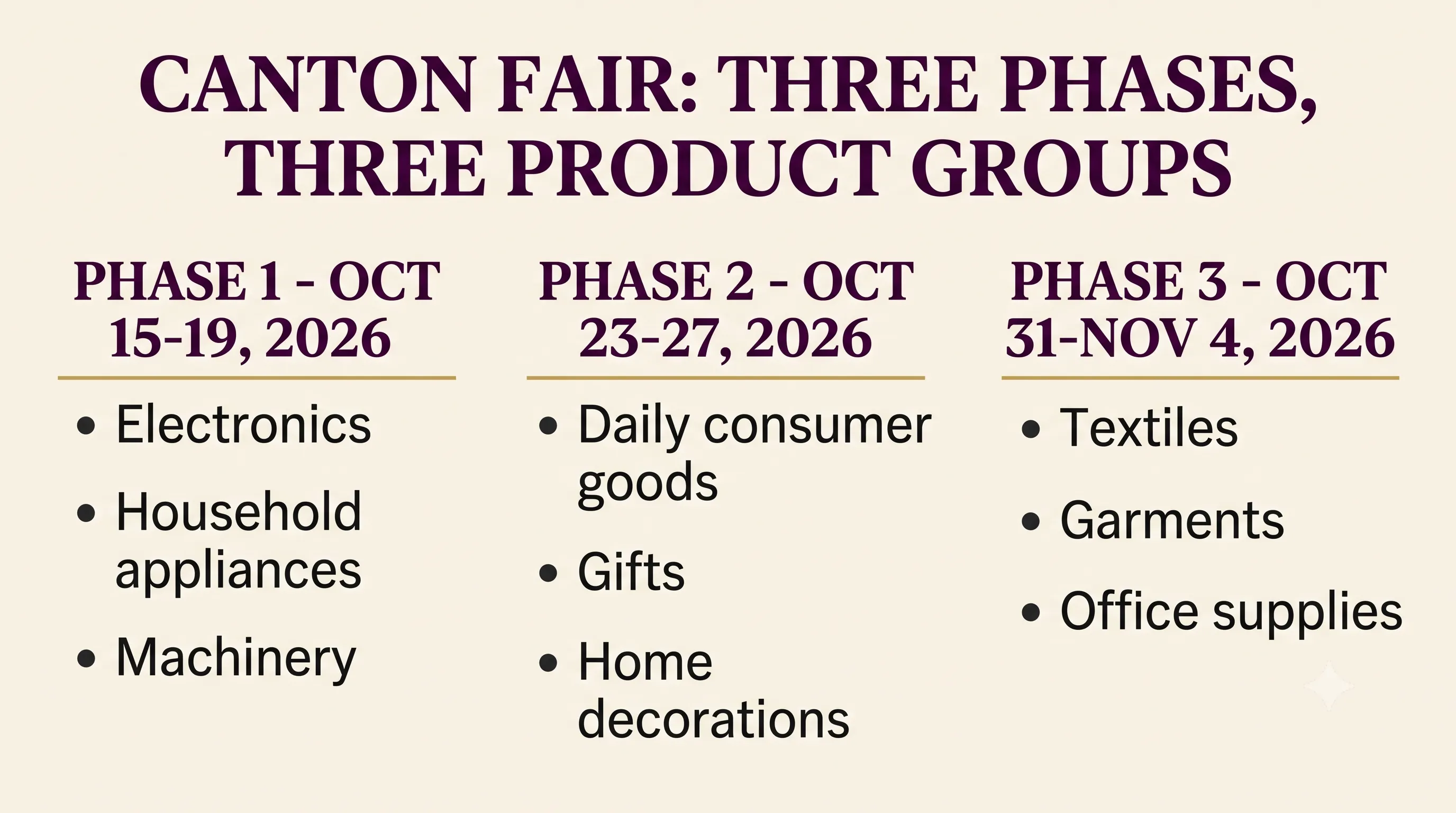
Phase 1 covers electronics, household appliances, and machinery and runs 15 to 19 October 2026. Phase 2 covers daily consumer goods, gifts, and home decorations and runs 23 to 27 October 2026. Phase 3 covers textiles, garments, and office supplies and runs 31 October to 4 November 2026. Phase 1 and Phase 3 are the most popular phases for African buyers attending the Fair.
How do I handle samples after the Canton Fair?
Request a paid sample from each shortlisted supplier, with the SKU, specification, and packaging agreed in writing. Pay for the sample only to a corporate account matching the supplier's registered Chinese entity. Evaluate the sample against four criteria: material consistency, dimensional accuracy, packaging suitability, and the supplier's communication discipline during the sample cycle. For high-value orders, commission independent laboratory testing on the sample — fibre composition for textiles, material grade for machinery, base metal thickness for building materials. The cost of testing is trivial compared to the cost of a full container of non-compliant goods.
Related Articles

Why 60% of African Importers Miss Out on AfCFTA Duty Savings (and How to Claim Yours)
A single 60% African-content threshold decides whether your goods cross the border duty-free or get hit with full MFN duty. How to document your supply chain, qualify, and claim the saving before your next shipment.
The 5-Minute Trick That Catches 9 Out of 10 Fraudulent Freight Forwarders
A Mombasa buyer lost $38,000 to a fake freight forwarder in 96 hours. Don't be next. Seven verification checks — licensing, bonding, references — and the one red flag that ends the deal.

The 4 Decisions Every Diaspora Buyer Gets Wrong on Their First China Order
Over $50B in remittances flows to Africa annually — but first-time diaspora importers lose their capital on bad suppliers, wrong specs, and unverified freight. Five steps to source from China without becoming a statistic.

The 3 LC Discrepancies That Cost African Buyers $50K+ Per Shipment
65-75% of documentary credit presentations are flagged for discrepancies on first review. The three highest-frequency failure points, how to fix each one, and when an LC is the wrong instrument entirely.
Don't Learn About a Scam After You've Wired the Money
One short email per week. Real trade risk intelligence — supplier red flags, regulatory changes, and verification checklists. Before the wire, not after the loss.