
The 5-Minute Trick That Catches 9 Out of 10 Fraudulent Freight Forwarders

A buyer in Mombasa wired USD 38,000 to a freight forwarder quoting USD 2,100 per cubic metre for a 40-foot container of building materials from Guangzhou. The forwarder booked nothing. Within 96 hours, the email replies stopped, the WhatsApp number was disabled, and the company website went offline. By the time the buyer's bank attempted to recall the wire, the funds had already been swept through two intermediary accounts in Hong Kong. The container never existed.
The pattern is consistent across verified buyer complaints from 2024-2026: an advance-fee deposit is collected in the buyer's name, no booking is placed with the actual shipping line, and the funds disappear within days. FIATA, the International Federation of Freight Forwarders Associations, has repeatedly warned its members about fraudulent operators targeting importers across Africa and South-East Asia.
Below are the seven verification steps that would have stopped that Mombasa buyer's wire before it left the account — plus four red flags that should end any forwarder conversation immediately, and what to do if the wire has already gone out.
How Container Shipping Fraud Actually Works
Container shipping fraud against African importers is dominated by a single pattern: the advance-fee booking scam. The mechanics are predictable.
The forwarder approaches the buyer through a B2B platform listing, an Alibaba supplier's recommendation, or a direct outreach email. The quoted rate is 10-25% below competing quotes — enough to draw attention without raising immediate suspicion. The forwarder asks for a 30% deposit "to secure the booking" before any shipping line is named. The wire is sent to a corporate account in mainland China or Hong Kong. Within 72 hours, contact becomes sporadic, then stops.
The funds are not always lost to a single operator. Several documented cases from 2025 trace the wire through three or four intermediary accounts, often split across jurisdictions, before final withdrawal. Recovery depends entirely on how quickly the buyer's issuing bank can file a recall request — and the window is typically less than 48 hours.
A second, less common pattern involves the legitimate-but-distressed forwarder. In this case, the operator is real, licensed, and bonded — but financially overstretched. They accept the deposit, then file for insolvency before placing the booking. The buyer's deposit becomes an unsecured creditor claim. This pattern accelerated during the Red Sea rerouting of 2024-2025, when freight rate volatility squeezed thinner operators out of the market. FIATA's January 2024 position paper called for global monitoring and coordination of the disruption, citing exactly this failure mode as a foreseeable consequence.
A third pattern is the legitimate-but-deceptive forwarder who quotes one rate, substitutes a lower-class carrier, and pockets the difference. The cargo moves, but the buyer has paid for service that was not delivered. This is harder to detect in advance and only surfaces when the shipment is delayed, the container is offloaded at the wrong port, or the bill of lading names a different carrier than the one originally quoted.
The single rule that covers all three patterns is the same: a forwarder who pressures for an immediate deposit, refuses to name the underlying shipping line, or asks for the wire to a non-corporate account is not safe to deal with. Every legitimate verification check below is designed to expose the operator before a wire is sent.
The Licensing Check That Takes Five Minutes
The fastest verification check is the licensing search. Every freight forwarder operating internationally should be registered with at least one of three categories of authority: a national freight forwarding association, a global body such as FIATA, or a transport regulator in the country of operation.
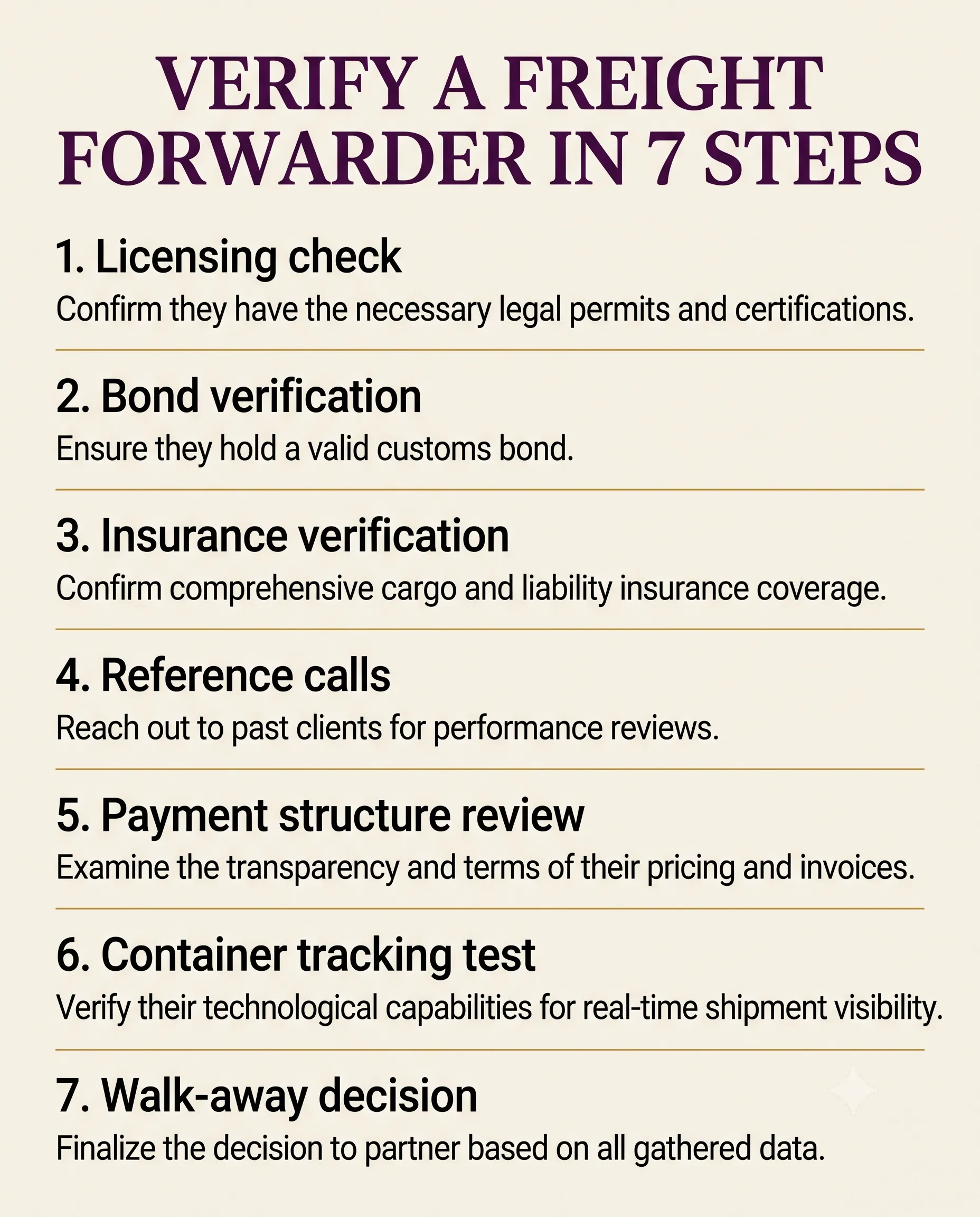
For African importers, the local association is the first stop. Kenya International Freight and Warehousing Association (KIFWA) maintains a member directory of licensed forwarders operating in Kenya. The South African Association of Freight Forwarders (SAAFF) and the Ghana Shippers' Authority maintain similar listings. For buyers sourcing through diaspora channels, FIATA's member directory provides a cross-checkable global registration. For US-domiciled forwarders handling Africa-bound cargo, the Federal Motor Carrier Safety Administration (FMCSA) maintains a freight forwarder registration database under 49 U.S.C. 13903.
The check itself is short: open the registry, search by company name, confirm the registration is current and matches the legal name on the forwarder's quote letter and invoice. If the name does not match, or if the registration is expired or absent, the conversation should end. A legitimate forwarder will not object to being verified.
Counter to the common advice that any licensed forwarder is safe, licensing is a floor, not a ceiling. The licensed operator filing for insolvency is still licensed at the moment of accepting the deposit. Licensing tells the buyer that the operator has met a minimum threshold; it does not guarantee financial standing. Treat licensing as the first filter, not the final one.
Bonding and Insurance: What a Legitimate Forwarder Carries
Two documents distinguish a bonded forwarder from an unbonded one: a freight forwarder bond and a cargo liability insurance certificate. Both should be requested before any wire is sent, and both should be verified independently with the issuing party.
A freight forwarder bond is a financial guarantee, typically issued by a surety company, that protects customers in the event the forwarder fails to perform its contractual obligations. Bonds are a regulatory requirement in some jurisdictions and an industry standard in others. A forwarder that cannot produce a bond certificate, or that produces one without a verifiable surety counterparty, is materially higher risk than a bonded competitor.
Cargo liability insurance covers the forwarder's statutory liability for loss or damage to cargo in their custody. The certificate should name the insurer, the policy number, the coverage limit, and the policy effective date. The buyer should contact the insurer directly using contact details from the insurer's own website — not from the certificate itself — to confirm the policy is in force.
The verification procedure takes ten minutes per document. The cost of skipping it is the entire deposit. There is no scenario in which a serious forwarder objects to producing both documents and waiting for verification before accepting a wire.
| Document | What it proves | How to verify |
|---|---|---|
| Freight forwarder bond | Financial guarantee against default | Contact the named surety company directly |
| Cargo liability insurance | Coverage for loss/damage in transit | Contact the named insurer directly |
| Trade association membership | Industry standing and peer accountability | Cross-check on FIATA or local association directory |
| Export licence (China-origin) | Authority to handle China outbound cargo | Verify via China Customs or MiYIT ICP record |
Reference Checks: The Three Calls That Expose a Fraud
Reference checks are the single highest-yield verification step. A forwarder who has handled ten or more Africa-bound container shipments in the past 24 months can produce three buyer references within an hour. A fraudulent operator either cannot produce references, or produces names that turn out to be unverifiable.
Request three references specifically from buyers who have shipped similar cargo (volume, route, product category) within the past six months. Then contact all three directly using phone numbers and email addresses the buyer verifies independently — not contact details supplied on the reference letter, which a fraudulent operator can fabricate.
The three questions that matter most during the reference call:
- Did the cargo arrive within the agreed transit window?
- Did any dispute arise over fees, demurrage, or storage at destination?
- Would you ship with this forwarder again?
A pattern of vague or evasive answers is itself a signal. A forwarder whose references cannot answer the third question with a clear "yes" should be treated as higher risk regardless of licensing and bonding status.
Payment Structure Red Flags
Payment structure reveals more about a forwarder's risk profile than any single document. Three patterns are red flags:
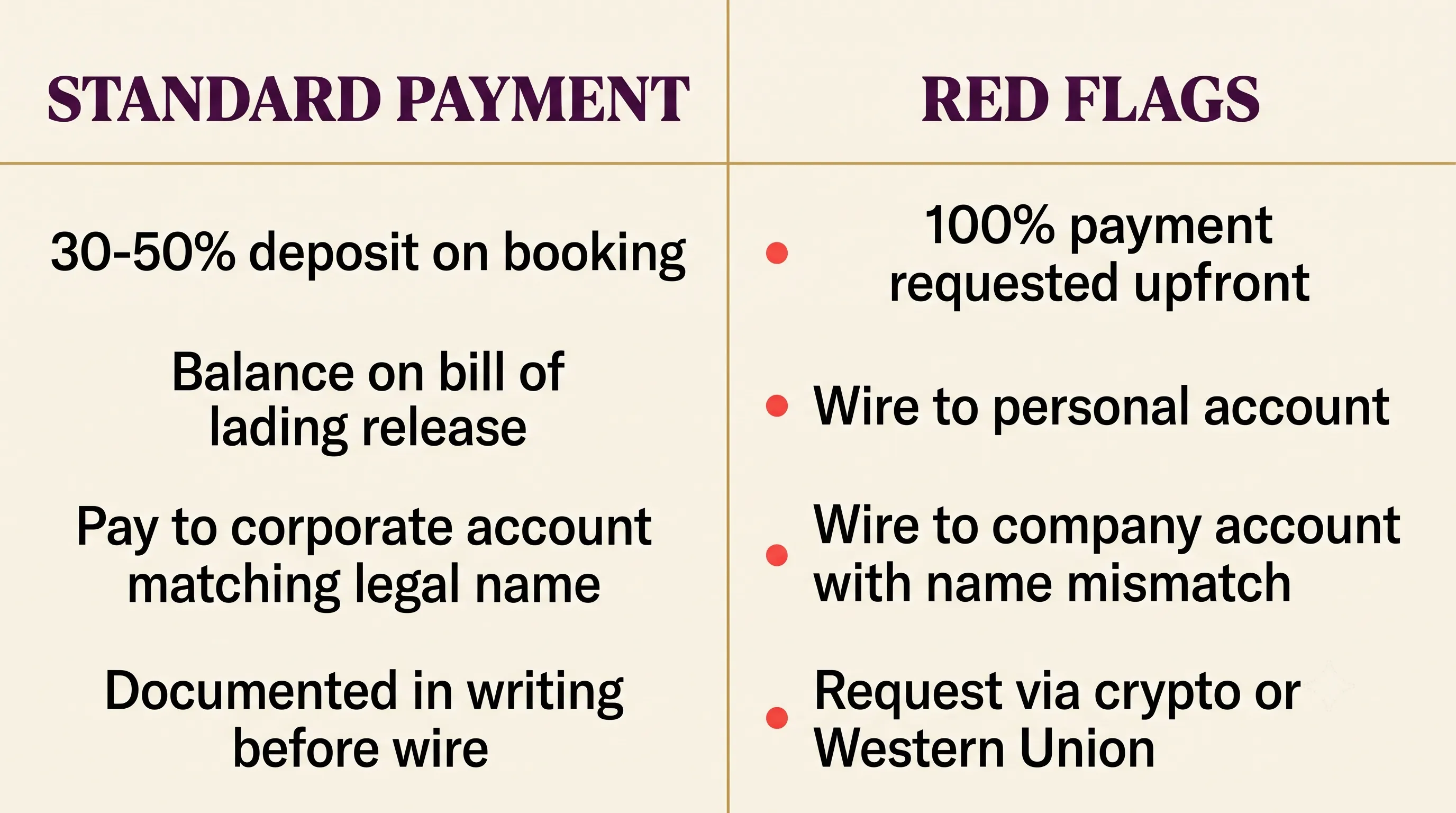
A request for 100% payment before pickup is the clearest disqualifier. Standard practice is 30-50% deposit on booking, with the balance payable against bill of lading release or on confirmed vessel departure. A forwarder insisting on full prepayment is either financially distressed or operating a fraud.
A request to wire to a personal account, or to a corporate account whose name does not match the forwarder's registered legal name, is the second disqualifier. Funds wired to a personal account are unrecoverable in nearly every jurisdiction. A corporate account with a slightly different name (a translation variant, a parent entity, a "trading as" variation) requires written confirmation and an explanation.
A request to pay via cryptocurrency, Western Union, or MoneyGram is the third disqualifier. These channels are designed for untraceability and provide no documentary trail the buyer's bank can use to support a recall.
The standard payment protocol is straightforward: 30% deposit on confirmed booking, balance on bill of lading release, paid only to a corporate account matching the forwarder's registered legal name. Document the payment instruction in writing, signed by both parties, before any wire is sent.
The Container Tracking Test
The container tracking test is the verification step most buyers skip. Once a forwarder has confirmed a booking and a vessel name, the buyer should be able to pull the container number from the booking confirmation and track it on the shipping line's official website — not on the forwarder's portal, but on the carrier's own tracking page.
Maersk, MSC, CMA CGM, COSCO, and Hapag-Lloyd all maintain public-facing container tracking. If the booking confirmation provides a container number that does not appear on the carrier's site, or that appears under a different shipper name, the booking is either fabricated or has been resold. Either way, the deposit is exposed.
This check is free and takes thirty seconds. A fraudulent forwarder who has accepted a deposit without placing a booking cannot produce a verifiable container number. The check exposes the fraud before any cargo moves.
What to Do If You Have Already Wired the Deposit
Once the wire is sent, the recovery window is narrow — typically under 48 hours. The procedure has three steps, in order.
Step one is to contact the issuing bank and request a wire recall. The bank will file a recall request with the receiving bank, but success depends on whether the receiving bank acts before the funds are withdrawn. The earlier the request, the higher the chance of recovery.
Step two is to file a police report in the forwarder's jurisdiction. If the forwarder claims to operate from Guangzhou, the report is filed in Guangdong. If the wire landed in Hong Kong, the report is filed in Hong Kong. Local police reports are required for any subsequent cross-border enforcement action. They also create a documentary record for the buyer's bank.
Step three is to engage a recovery specialist. Several firms in Hong Kong, Singapore, and London specialise in advance-fee fraud recovery for African and diaspora clients. Their fees are typically 10-25% of recovered funds, payable only on success. They coordinate with the receiving bank, file civil action where appropriate, and trace funds through intermediary accounts.
Time is the variable that determines outcome. The longer the wire sits unrecovered, the lower the probability of recovery. The buyer's first action after a suspicious wire should be the bank recall call, not the police report.
When to Walk Away (Even If the Rate Is Good)
The cheapest quote is almost always the most expensive in the end. A forwarder quoting 15-25% below market is pricing below their actual cost of service — and the only way to honour the quote is to cut corners, substitute carriers, or abscond with the deposit. None of those outcomes serves the buyer.
The threshold to walk away is lower than most buyers assume. Any one of the following signals is sufficient to end the conversation: no verifiable registration on FIATA or the local association, no bond certificate, no verifiable insurance, no references reachable by direct contact, pressure to wire before booking confirmation, a quote that is 15%+ below the next cheapest competing quote, or a payment instruction to an account name that does not match the forwarder's legal entity.
Two signals together should be a hard stop. Three or more is unambiguous fraud.
The freight rate is recoverable. The wired deposit is not.
For the buyer-side documentation you should keep alongside the freight booking — Incoterm specification, packing list standards, and the verification dossier you should already have on the supplier — see our Buyer Resources. For a worked example of buyer-side verification on a heavy shipment, our rebar grade verification guide walks through the same documentary discipline applied to a USD 180,000 building materials order.
A Note on What We Do
Rumali Supreme does not buy, sell, or take title to commodities — including gold, minerals, machinery, apparel, building materials, vehicles, and consumer goods. We facilitate cross-border transactions between buyers and vetted suppliers, charging a fixed facilitation fee for verification-only engagements and a percentage on successful transactions when our role extends to sourcing, payment coordination, or shipment oversight. Our reports, checklists, and blog content describe facilitation methodology only; they are not legal, tax, or financial advice, and should be read alongside current regulations in the jurisdictions involved.
Frequently Asked Questions
How do I verify a freight forwarder is legitimate?
Run three checks before wiring anything. First, verify licensing with the relevant national authority or with FIATA's member directory. Second, confirm the forwarder holds a freight forwarder bond and cargo liability insurance, and verify both documents directly with the issuing surety and insurer. Third, request three references from previous buyers handling similar cargo on similar routes, and call all three directly using independently verified contact details.
What are the red flags of a freight forwarder scam?
The four clear disqualifiers are: a quote 15-25% below the next competing quote, pressure to wire a deposit before the booking is confirmed, a request that the wire be sent to a personal account or to an account name that does not match the forwarder's registered legal entity, and an inability to produce verifiable references reachable by direct phone call. Two or more of these signals together should end the conversation. A single signal warrants deeper investigation before any wire is sent.
Should I pay a freight forwarder before they pick up my container?
Standard practice is a 30-50% deposit on confirmed booking, with the balance payable on bill of lading release. Never pay 100% upfront. Never pay to a personal account. Pay only to a corporate account matching the forwarder's registered legal name, and document the payment instruction in writing before any wire is sent. If the forwarder resists any of these terms, walk away.
How do I check if a freight forwarder is licensed?
Start with the freight forwarder's home-country regulator. In the United States, the Federal Motor Carrier Safety Administration maintains the freight forwarder registration database under federal bonding requirements. In the United Kingdom, HMRC and the British International Freight Association maintain member directories. For African-bound cargo, the local African freight association (KIFWA in Kenya, SAAFF in South Africa) maintains member lists. Globally, FIATA's member directory provides a cross-checkable registration.
What is a freight forwarder bond and why does it matter?
A freight forwarder bond is a financial guarantee issued by a surety company that protects customers if the forwarder fails to perform. It is a regulatory requirement in some jurisdictions and an industry standard in others. A bonded forwarder carries insurance against default; an unbonded one does not. Request the bond certificate, then verify it directly with the named surety company using contact details from the surety's own website, not from the certificate.
How do I recover cargo from a fraudulent freight forwarder?
The recovery procedure has three steps in order: contact the issuing bank and request a wire recall within 48 hours, file a police report in the forwarder's claimed jurisdiction, and engage a recovery specialist in Hong Kong, Singapore, or London to coordinate with the receiving bank and trace funds through intermediary accounts. Recovery fees are typically 10-25% of recovered funds, payable on success. Time is the variable that determines outcome — the longer the wire sits unrecovered, the lower the probability of recovery.
Related Articles

Why 60% of African Importers Miss Out on AfCFTA Duty Savings (and How to Claim Yours)
A single 60% African-content threshold decides whether your goods cross the border duty-free or get hit with full MFN duty. How to document your supply chain, qualify, and claim the saving before your next shipment.

What 73% of Canton Fair Buyers Miss in the First 48 Hours (2026 Checklist)
Autumn 2026 Canton Fair runs 15 Oct–4 Nov. Most orders placed on first contact fail within 90 days. Ten pre-flight checks — plus three red flags that should stop any wire before you fly home.

The 4 Decisions Every Diaspora Buyer Gets Wrong on Their First China Order
Over $50B in remittances flows to Africa annually — but first-time diaspora importers lose their capital on bad suppliers, wrong specs, and unverified freight. Five steps to source from China without becoming a statistic.

The 3 LC Discrepancies That Cost African Buyers $50K+ Per Shipment
65-75% of documentary credit presentations are flagged for discrepancies on first review. The three highest-frequency failure points, how to fix each one, and when an LC is the wrong instrument entirely.
Don't Learn About a Scam After You've Wired the Money
One short email per week. Real trade risk intelligence — supplier red flags, regulatory changes, and verification checklists. Before the wire, not after the loss.