
The 4 Decisions Every Diaspora Buyer Gets Wrong on Their First China Order

A Ghanaian nurse working in Manchester saved £12,000 over two years to import a container of building materials for a family home in Accra. He found a supplier on Alibaba, negotiated a price over WhatsApp, and wired the full amount. The shipment arrived — 30-gauge mabati instead of the 28-gauge he'd ordered, mismatched tile lots, and cement that had hardened in transit. No pre-shipment inspection. No independent verification. No recourse.
Diaspora buyers are the most structurally overlooked segment of China-Africa trade. Over USD 50 billion in remittances flows to Sub-Saharan Africa annually — and a meaningful share of it could support direct sourcing from China. The diaspora buyer's advantage is strong: foreign currency, international payment rails, and a personal network back home. The disadvantage is distance, time-zone friction, and no in-person factory visits. This playbook closes that distance with documentation, not assumptions.
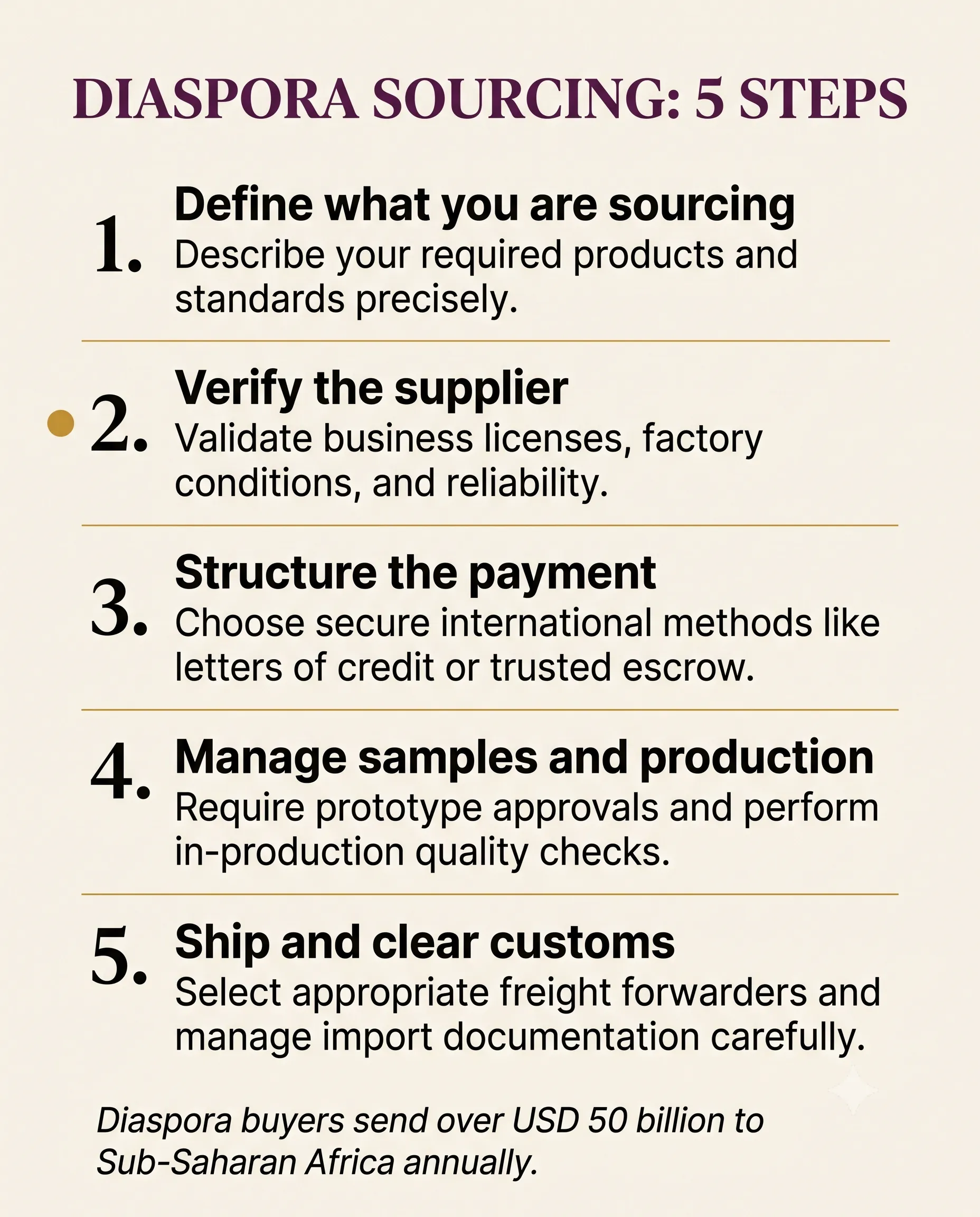
This is a five-step playbook for the diaspora buyer who has decided to source from China. It walks through defining the sourcing need, verifying the supplier, structuring the payment, managing samples and production remotely, and shipping to the home country. It also covers the role a sourcing facilitator actually plays, and the most common diaspora sourcing mistakes.
In This Guide
For the underlying China supplier verification framework, see our Diaspora Sourcing service and our China sourcing verification guide. For documentary discipline on the payment side, see our Letters of Credit in China-Africa Trade guide. For broader buyer resources, see Buyer Resources and our machinery verification guide.
Why Diaspora Buyers Are Different (And Better Positioned Than They Realise)
Diaspora buyers are categorically different from domestic Chinese procurement agents and from in-country African importers, and the differences are mostly advantages.
The first difference is currency. Diaspora buyers earn in pounds, dollars, dirhams, or Canadian or Australian dollars, and they hold the foreign currency needed to wire international payments. The diaspora buyer does not need to navigate the African foreign exchange controls that constrain many domestic importers. The diaspora buyer can wire USD or EUR from a UK or US bank account to a Chinese supplier in the same currency, in the same day, at a competitive FX rate. The diaspora buyer's currency position is structurally superior to the domestic African importer's.
The second difference is the network. The diaspora buyer typically has family or business contacts in the home country who can receive the shipment, clear customs locally, and distribute the goods. The diaspora buyer does not need to establish a local distribution infrastructure — the network is already in place. The diaspora buyer's challenge is to coordinate the network across time zones, not to build it from scratch.
The third difference is digital access. The diaspora buyer can run the same supplier verification checks as a professional procurement agent: business licence check via NECIPS, export record verification, video factory tour, and reference calls. The diaspora buyer is not dependent on a local agent to run these checks.
The fourth difference is the disadvantage — distance. The diaspora buyer cannot visit the factory in person without a flight, cannot inspect the goods physically, and cannot sit in the supplier's office to push for faster delivery. The diaspora buyer is dependent on the supplier's written communication, photographic evidence, and video walk-throughs. The diaspora buyer's distance is the operational risk that the rest of the playbook is designed to mitigate.
Step 1: Decide What You Are Sourcing and Why
The first step is the most under-discussed. Before any supplier search, the diaspora buyer must define the product, the volume, the target landed cost, and the use case. The definition determines every subsequent decision.
The product definition should be specific: SKU, specification, packaging, and any compliance requirements for the destination market. "Apparel" is too broad — "men's cotton t-shirts, 180gsm, screen-printed with our organisation logo, packed in individual polybags and master cartons of 50" is specific. The specificity determines whether the supplier can quote accurately, whether the sample matches the production run, and whether the shipment clears customs on arrival.
The volume definition determines the cost per unit and the freight mode. Air freight is faster but 5-8 times more expensive per kilogram than sea freight. For diaspora buyers shipping household items or small retail orders, sea freight LCL (less than container load) is the default. For high-value or time-sensitive items, air freight is justified.
The target landed cost is the all-in cost including product, freight, insurance, duties, and last-mile delivery. The diaspora buyer should set a target landed cost per unit before engaging suppliers. The target sets the negotiation anchor and prevents scope creep on specifications or freight mode.
The use case determines the documentation requirements. For personal household items, the shipment is a personal effects declaration in most countries, with lower duty rates. For business inventory, the shipment is a commercial import with full duty, VAT, and possibly pre-shipment inspection. For resale, the shipment may require a trade licence in the destination country. The use case is determined at step 1, not at customs.
Counter to the common assumption that the diaspora buyer's first task is finding a supplier, the first task is defining the product and the cost framework. The supplier search is the second task.
Step 2: Verify the Supplier Before You Fly or Wire
The verification step applies the same framework any professional buyer uses on a Chinese supplier. Five checks are the minimum.
The first is the business licence check. Request the supplier's 18-digit Unified Social Credit Code and verify it against the NECIPS database. The check confirms the company exists, what it is registered to do, and whether it is in good standing.
The second is the export record check. Request the supplier's export records for the past two years and verify them against China Customs. The check confirms the supplier has shipped your product category to your destination country before, and confirms the scale of their export activity.
The third is the video factory tour. Request a 15-minute live video walk-through of the production floor. The tour should show the production line, warehouse, quality control station, and ideally the office. The tour is your only substitute for the in-person visit. A supplier who refuses a video tour is signalling that they are not a manufacturer, or not the manufacturer they claim to be.
The fourth is the reference check. Request three references from previous international buyers, ideally buyers in your destination country or your product category. Contact all three directly using phone numbers and email addresses you verify independently.
The fifth is the sample evaluation. Order paid samples (USD 30-200 plus courier) from the top three candidates. Evaluate the samples against your specification, photograph the samples, and confirm the sample matches what the supplier can produce at scale.
A diaspora buyer who skips any of these five checks is exposing the shipment to the same failure modes as any other first-time importer. The verification step is the same for a UK-based diaspora buyer, a US-based diaspora buyer, and a UAE-based diaspora buyer. The country of residence does not change the verification framework.
Step 3: Structure the Payment to Protect the Deposit
The payment structure is the diaspora buyer's most controllable risk. The standard structure is 30% deposit on confirmed purchase order, 30% on first article sample approval, and 40% balance against a clean pre-shipment inspection report and bill of lading.
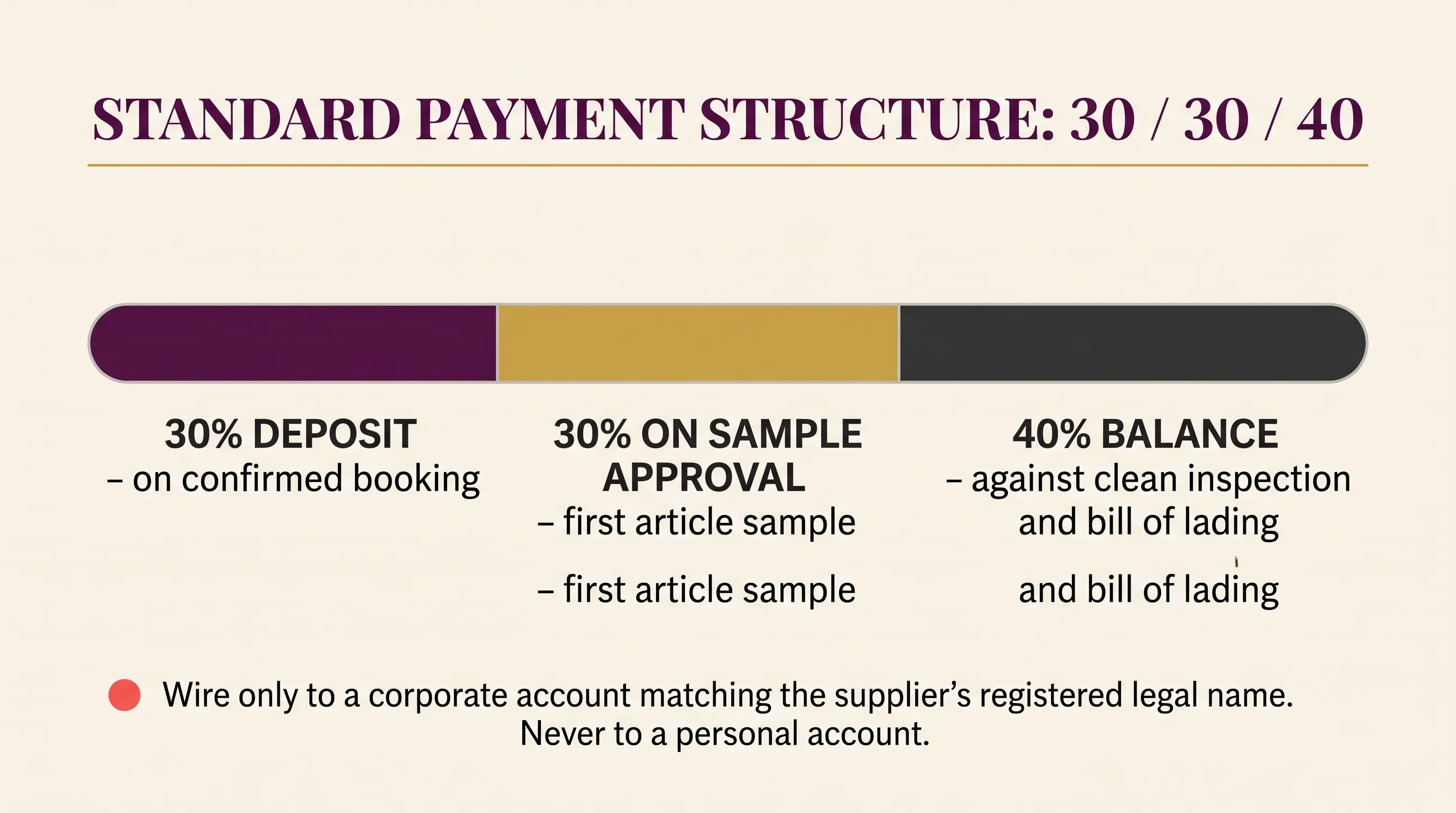
The 30/30/40 structure aligns the supplier's incentives with the buyer's. The deposit gives the supplier working capital to start production. The second payment confirms the sample matches the specification. The balance is paid only after an independent inspection confirms the production run matches the sample, and only after the bill of lading is issued — meaning the goods are physically in transit to the destination port.
For amounts above USD 50,000, the diaspora buyer should consider an irrevocable letter of credit. The LC framework is more expensive than a telegraphic transfer (typically 1-3% of the LC value plus issuing and advising fees), but it provides bank-level payment security. The LC is documented in detail in our Letters of Credit in China-Africa Trade guide.
Three payment rules apply universally. Never pay 100% upfront. Never pay to a personal account. Pay only to a corporate account matching the supplier's registered Chinese entity name. Any payment instruction that violates any of these three rules is a disqualifier.
Step 4: Manage Samples and Production Remotely
The diaspora buyer's distance from the factory creates a sample and production management challenge. The solution is structured communication, photographic evidence, and independent inspection.
The sample cycle should follow a documented process. The buyer issues a specification, the supplier prepares a sample, the sample is shipped via express courier (typically DHL or FedEx, 3-7 days from China to most diaspora destinations), the buyer evaluates the sample, the buyer issues written approval or revision requests, the supplier prepares a revised sample if needed, and the cycle repeats until the buyer signs off. Two sample rounds are normal; three rounds suggest a communication or quality problem.
Production monitoring requires weekly status updates from the supplier with photographic evidence. The buyer should request photos of the production line at the start of the run, the middle, and the end. For higher-value shipments, the buyer should commission an independent pre-shipment inspection (PSI) from a third-party agency — typically SGS, Bureau Veritas, Intertek, or a smaller regional firm. The PSI inspector visits the factory, checks the production output against the approved sample, and issues a pass-or-fail report. The 40% balance is paid only against a clean PSI report.
The communication discipline is the binding constraint. The buyer must respond to supplier queries within 24 hours during the working week, even if the response is "let me get back to you on that." A diaspora buyer who goes silent for a week during production risks the supplier pausing the run or substituting materials to manage their own cash flow.
Step 5: Shipping, Customs, and Home-Country Delivery
The shipping step has four sub-decisions: freight mode, freight forwarder, customs clearance, and last-mile delivery.
For freight mode, sea freight LCL is the default for diaspora buyers shipping 1-15 cubic metres. Sea freight FCL (full container load) is the default for 15 cubic metres and above. Air freight is 5-8 times more expensive per kilogram and is justified only for time-sensitive or high-value items. The transit time from China to Mombasa is 25-35 days by sea; to Lagos is 30-40 days; to Tema is 35-45 days; to Dar es Salaam is 25-35 days. Transit time is the binding constraint on whether the shipment arrives before the diaspora buyer's deadline.
The freight forwarder should be selected for experience shipping to the destination country, not for the lowest rate. Verify the forwarder's credentials against the FIATA member directory or a local African freight association, confirm the bond and insurance, and request three references from previous diaspora or African-bound shipments. The verification procedure is documented in detail in our Container Shipping Fraud guide.
Customs clearance in the destination country is typically handled by a licensed clearing agent. The clearing agent files the import declaration, pays the duties and taxes, and releases the cargo. The diaspora buyer should engage the clearing agent in advance — not when the cargo arrives at the port. For East Africa, the standard pre-shipment inspection regime (PVOC for Kenya, similar programmes in Tanzania and Uganda) requires the diaspora buyer to initiate the inspection request before the cargo ships. For West Africa, SONCAP for Nigeria and similar programmes apply. The pre-shipment regime determines the documentary chain; the diaspora buyer should confirm the destination's requirements before the supplier ships.
Last-mile delivery is typically handled by the diaspora buyer's network in the home country — a family member, a business contact, or a local logistics company. The diaspora buyer should coordinate the last-mile contact before the cargo arrives, not after.
The Roles a Sourcing Facilitator Actually Plays
A sourcing facilitator handles the parts of the workflow the diaspora buyer cannot perform from abroad. The roles are specific and operational, not advisory.
The first role is supplier pre-screening. The facilitator runs the NECIPS check, export record check, and reference calls on the buyer's shortlisted suppliers. The buyer retains the final selection authority.
The second role is sample coordination. The facilitator receives samples at a Chinese consolidation warehouse, photographs them, and forwards to the buyer. The facilitator also coordinates supplier revisions and physical sample quality checks that the buyer cannot perform remotely.
The third role is production monitoring. The facilitator conducts factory visits during the production run, photographs the line, and reports progress to the buyer. For higher-value shipments, the facilitator commissions the pre-shipment inspection.
The fourth role is shipping coordination. The facilitator books the freight forwarder, prepares the export documentation, and coordinates with the destination clearing agent. The facilitator is the buyer's representative on the ground in China.
The fifth role — and the one most diaspora buyers do not realise they need — is dispute resolution. If the supplier substitutes materials, delays shipment, or disputes the quality, the facilitator has the local presence and the language fluency to resolve the issue without the diaspora buyer needing to fly to China.
The facilitator fee structure is typically 5-10% of the order value for full-service engagements, with lower fees for specific roles. The fee is recovered by the avoided mistakes — the sample that arrives wrong and must be redone, the production run that fails pre-shipment inspection, the freight forwarder who is not actually licensed.
Common Diaspora Sourcing Mistakes (And How to Avoid Them)
Six mistakes appear repeatedly in diaspora sourcing failures. Each is avoidable.
The first is using a personal bank account for the deposit. The supplier requests payment to a personal account to "avoid the company tax." The diaspora buyer pays, the deposit disappears, and the supplier disappears. The fix is a hard rule: corporate account only, matching the supplier's registered name.
The second is accepting the first sample as the production standard. The sample is good. The production run is not. The fix is the approved-sample lock — photograph the approved sample, write it into the purchase contract, and reference the photo in any pre-shipment inspection. The PSI inspector compares the production run against the approved sample, not against the supplier's verbal claim.
The third is skipping the pre-shipment inspection. The shipment leaves China. It arrives at destination with the wrong colour, the wrong size, or the wrong quantity. The fix is a mandatory PSI for any shipment above USD 5,000.
The fourth is using a freight forwarder because they quoted the lowest rate. The cheapest rate is almost always the most expensive in the end. The fix is the same verification procedure as for the supplier — NECIPS-equivalent registration, bond, insurance, references.
The fifth is forgetting the destination's pre-shipment regime. The shipment arrives at the destination port without a PVOC or SONCAP certificate. The cargo is held. The fix is to confirm the destination's pre-shipment requirements before the supplier ships, and to initiate the inspection request at least three weeks before the planned shipment date.
The sixth is going silent during production. The diaspora buyer's work and family commitments pull them away. The supplier interprets silence as a signal to pause the run or substitute materials. The fix is a weekly status update — even a "still on track, no action needed" message is enough to keep the run on schedule.
A Note on What We Do
Rumali Supreme does not buy, sell, or take title to commodities — including gold, minerals, machinery, apparel, building materials, vehicles, and consumer goods. We facilitate cross-border transactions between buyers and vetted suppliers, charging a fixed facilitation fee for verification-only engagements and a percentage on successful transactions when our role extends to sourcing, payment coordination, or shipment oversight. Our reports, checklists, and blog content describe facilitation methodology only; they are not legal, tax, or financial advice, and should be read alongside current regulations in the jurisdictions involved.
Frequently Asked Questions
How do I source goods from China if I live abroad?
The diaspora sourcing workflow has five stages. Define what you want and why, verify the supplier against the NECIPS database and conduct a video factory tour, structure payment in stages (typically 30/30/40), manage samples and production via a sourcing facilitator, and ship with marine insurance through a freight forwarder with experience shipping to your home country. The cost is typically 5-10% of the order value for a full-service facilitator, but the avoided mistakes are worth far more.
What is the easiest way to import from China to my home country?
There is no single easiest way, but the lowest-friction path is to engage a sourcing facilitator who has shipped to your specific home country. They handle supplier verification, payment structuring, quality control, and shipping coordination. The cost is typically 5-10% of the order value. For diaspora buyers doing their first shipment, the facilitator fee is recovered by the avoided first-time-importer mistakes.
Do I need a company in China to source from there?
No. You can place orders with a Chinese supplier from anywhere in the world without a Chinese entity. You do need a freight forwarder with experience shipping to your home country, and a sourcing facilitator to verify the supplier and manage quality. The cost of the facilitator and forwarder is materially less than the cost of a Chinese entity.
How do diaspora buyers handle payment to Chinese suppliers?
The standard practice is a 30/30/40 structure: 30% deposit to commence production, 30% on first article sample approval, and 40% balance against a clean pre-shipment inspection report and bill of lading. For amounts above USD 50,000, use an irrevocable letter of credit. Pay only to a corporate account matching the supplier's registered Chinese entity name. Never pay to a personal account or via cryptocurrency.
What is the cheapest way to import from China to Africa?
The cheapest shipping option is sea freight LCL (less than container load) for small volumes, or FCL (full container load) for volumes above 15 cubic metres. Air freight is 5-8 times more expensive per kilogram and is justified only for time-sensitive or high-value items. Plan for 25-45 days sea freight transit time from China to major African ports, depending on the destination.
How do I manage a supplier in China from overseas?
Use a combination of scheduled weekly video calls, shared project management tools, milestone-based payment releases tied to photographic or video evidence, and independent third-party inspections at production milestones. Engage a sourcing facilitator in China for the on-the-ground coordination that the diaspora buyer cannot perform from abroad. The facilitator's fee is recovered by the avoided mistakes and the faster issue resolution.
Related Articles

Why 60% of African Importers Miss Out on AfCFTA Duty Savings (and How to Claim Yours)
A single 60% African-content threshold decides whether your goods cross the border duty-free or get hit with full MFN duty. How to document your supply chain, qualify, and claim the saving before your next shipment.

What 73% of Canton Fair Buyers Miss in the First 48 Hours (2026 Checklist)
Autumn 2026 Canton Fair runs 15 Oct–4 Nov. Most orders placed on first contact fail within 90 days. Ten pre-flight checks — plus three red flags that should stop any wire before you fly home.
The 5-Minute Trick That Catches 9 Out of 10 Fraudulent Freight Forwarders
A Mombasa buyer lost $38,000 to a fake freight forwarder in 96 hours. Don't be next. Seven verification checks — licensing, bonding, references — and the one red flag that ends the deal.

The 3 LC Discrepancies That Cost African Buyers $50K+ Per Shipment
65-75% of documentary credit presentations are flagged for discrepancies on first review. The three highest-frequency failure points, how to fix each one, and when an LC is the wrong instrument entirely.
Don't Learn About a Scam After You've Wired the Money
One short email per week. Real trade risk intelligence — supplier red flags, regulatory changes, and verification checklists. Before the wire, not after the loss.