
Why 60% of African Importers Miss Out on AfCFTA Duty Savings (and How to Claim Yours)

A Lagos-based importer shipped USD 80,000 worth of processed cashew nuts from Kenya to Ghana in March 2026. The destination customs officer checked the Certificate of Origin, cross-referenced the supplier's value-add calculation, and denied the preferential tariff claim. The shipment was reassessed at Ghana's standard MFN rate: 20% of CIF. That single finding — that the supplier had sourced raw cashews from outside the continent and failed the Rules of Origin test — cost the importer USD 16,000 on one container. The deal had been profitable on paper. At the border, it wasn't.
The African Continental Free Trade Area has been operational since 2021. Over 40 AU member states have ratified it. The tariff schedule and digital infrastructure exist. But the operational gap between what AfCFTA promises and what a customs officer accepts at the border is where most African traders lose money — and the gap is almost always a paperwork failure, not a policy failure.
This is a practical guide for the African importer, exporter, or trade-finance professional who has heard AfCFTA exists and wants to know how to use it on a real transaction. It covers what AfCFTA actually changes for cross-border traders, the qualification criteria, the certificate of origin procedure, the Rules of Origin tests, the customs claim process, the most common rejection reasons, when AfCFTA is not worth the paperwork, and country-specific notes for Kenya, Ghana, Nigeria, and South Africa. For the underlying compliance verification on Africa-mineral shipments, see our Africa Sourcing coverage and our guide to ICGLR-aligned mineral certification. For broader African trade compliance resources, see Buyer Resources and our agricultural export compliance guide.
What AfCFTA Actually Changes for Cross-Border Traders
AfCFTA changes one operational fact for cross-border African traders: eligible goods moving between participating African states now travel at reduced or zero tariff, provided the goods meet the Rules of Origin and the trader presents a valid Certificate of Origin at the destination border. In the absence of AfCFTA, the same goods would travel at the destination country's standard MFN rate — typically 5-25% of CIF (Cost, Insurance, Freight) value depending on the product category and the country pair.
The change sounds mechanical, but the operational consequences are material. For a shipment of processed agricultural goods from Kenya to Ghana at a declared CIF value of USD 200,000, the difference between the MFN tariff (typically 20%) and the AfCFTA preferential tariff (typically 0% on liberalised lines) is USD 40,000. That saving is not theoretical — it is the difference between a viable trade margin and an unviable one. For a smaller shipment of USD 20,000 of manufactured goods from South Africa to Nigeria, the same calculation yields a saving of USD 4,000 against a 20% MFN tariff.
Counter to the common assumption that AfCFTA is only relevant for large industrial shipments, the structure of the agreement means that even small transactions can justify the compliance cost. The 2025-2026 wave of AfCFTA implementations has been specifically designed to reduce the per-shipment paperwork burden for small traders, with digital Certificate of Origin issuance, simplified Rules of Origin tests for low-value shipments, and reduced documentation requirements for first-time applicants. The economic logic of AfCFTA participation is not a function of shipment size; it is a function of the tariff differential between the MFN rate and the AfCFTA preferential rate for the product category.
The operational trade-off the trader must evaluate is simple: the tariff saving versus the compliance cost. The compliance cost includes the Certificate of Origin application fee, the documentary evidence required to demonstrate Rules of Origin compliance, the time required to obtain the certificate before shipment, and the risk of rejection at the destination border. For shipments where the MFN tariff is low (under 5%), the compliance cost often exceeds the saving. For shipments where the MFN tariff is 10% or higher, the compliance cost is almost always justified.
Who Qualifies and Which Goods Are Covered
AfCFTA qualification operates on two axes: trader eligibility and goods eligibility. Both must be satisfied for preferential tariff treatment to apply.
On the trader side, the exporter or importer must be registered in a participating state. Registration is typically handled by the national AfCFTA coordination body — for Kenya, the AfCFTA Coordination Office under the Ministry of Industrialisation, Trade and Enterprise Development; for Ghana, the Ghana National AfCFTA Coordinating Office; for Nigeria, the Nigerian AfCFTA Coordination Office. The registration process is generally free or low-cost and takes between one and four weeks depending on the country. The registered trader is then authorised to apply for Certificates of Origin for individual shipments.
On the goods side, the product must be covered by a tariff offer that the destination country has deposited with the AfCFTA Secretariat. Each participating country publishes a tariff schedule listing the product categories it has liberalised under the agreement. Most tariff offers cover 90% of tariff lines, with the remaining 10% consisting of politically or economically sensitive categories that are excluded from liberalisation. Excluded categories typically include arms and ammunition, certain agricultural products, and a small set of goods under infant-industry protection.
The African Union's AfCFTA Secretariat maintains the public-facing tariff schedule. The International Trade Centre's Trade Map provides a queryable interface for tariff offers by country pair and product category. UNCTAD publishes trade-flow data that supports the qualification assessment — if the trader's historical trade flow on a specific product and corridor is below the AfCFTA threshold, the application is unlikely to be processed efficiently. The World Bank's Africa trade publications provide the macroeconomic context, including country-by-country tariff baselines against which the AfCFTA saving is calculated.
The qualification test for goods is performed by the destination country's customs authority at the point of import. The customs officer compares the Certificate of Origin against the tariff offer schedule, verifies the goods classification code, and applies the preferential rate. If any element is missing or mismatched, the shipment falls back to the MFN rate.
The Certificate of Origin Procedure Step by Step
The Certificate of Origin is the documentary instrument that unlocks AfCFTA preferential treatment. The procedure has five steps, each with its own documentation requirements and processing time.
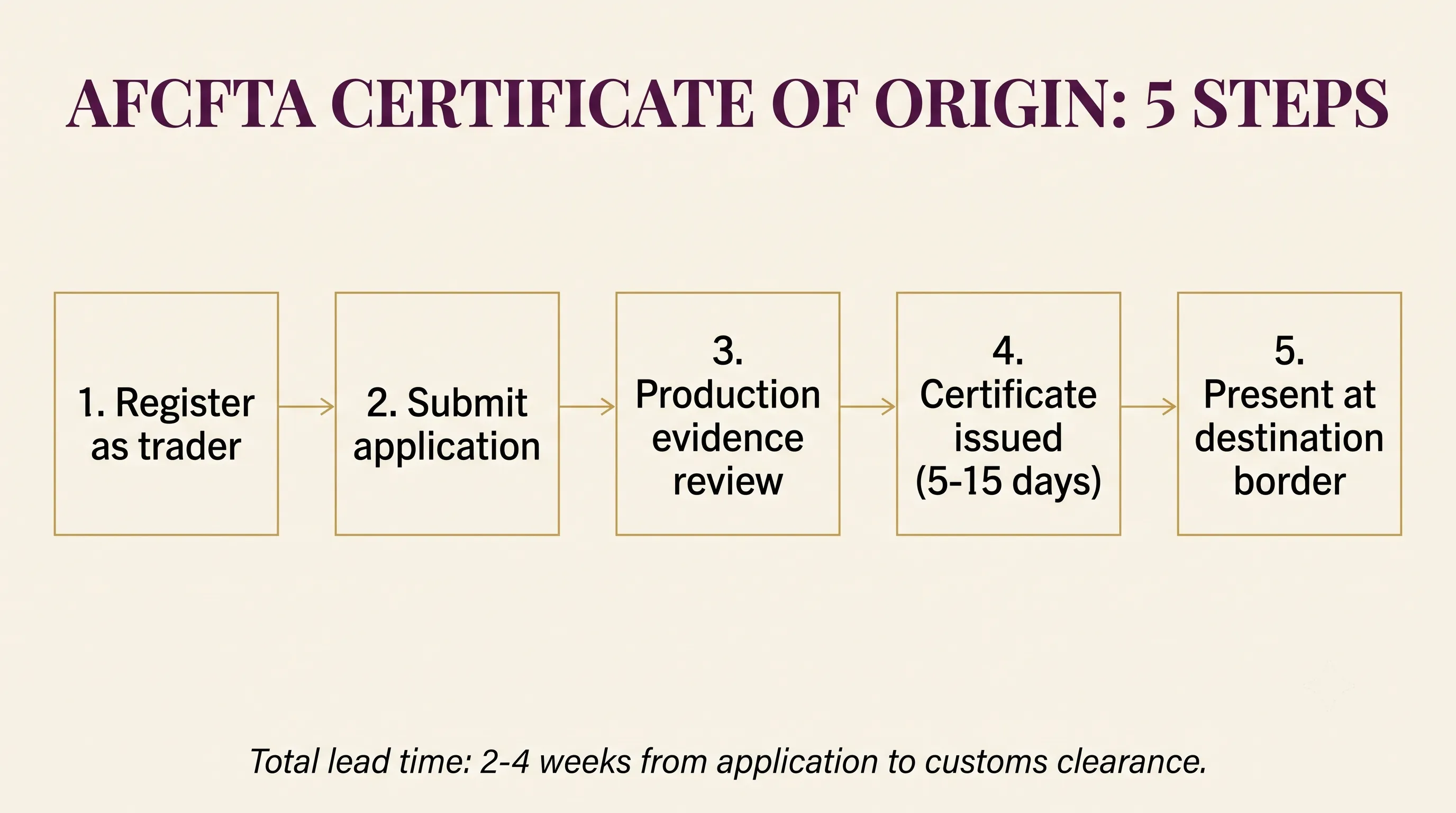
Step one is exporter registration. The exporter applies to the national AfCFTA coordination body in the exporting country, providing business registration documents, tax compliance certificates, and a profile of the product categories the exporter intends to ship under AfCFTA. Approval typically takes one to two weeks.
Step two is the per-shipment application. For each shipment, the exporter submits a Certificate of Origin application to the issuing authority, including the commercial invoice, packing list, production records (to demonstrate Rules of Origin compliance), and the application form. The issuing authority reviews the application against the Rules of Origin protocol for the product category.
Step three is the Rules of Origin evidence review. The issuing authority assesses whether the goods meet the qualifying criteria. For manufactured goods, this typically requires production records showing where the inputs were sourced and where the transformation occurred. For agricultural goods, this requires origin documentation from the farm or production facility.
Step four is certificate issuance. Once the application is approved, the issuing authority generates the AfCFTA Certificate of Origin, either as a paper document with official stamps or as a digital certificate with electronic signatures. The certificate is transmitted to the exporter, who attaches it to the shipment documentation.
Step five is presentation at the destination border. The exporter includes the Certificate of Origin in the shipment documents. The destination customs authority verifies the certificate, confirms the goods classification, and applies the AfCFTA preferential tariff treatment.
The total time from application to presentation is typically 5-15 working days, depending on the issuing country and the complexity of the product. For traders shipping perishable goods or goods under tight delivery windows, this timeline can be the binding constraint on whether AfCFTA participation is feasible.
Rules of Origin: The 60% Value-Add Test That Trips Most First-Timers
Rules of Origin are the criteria that determine whether a specific product qualifies as "African" enough to receive AfCFTA preferential treatment. The test varies by product category, but the most common is the 60% value-add test for manufactured goods.
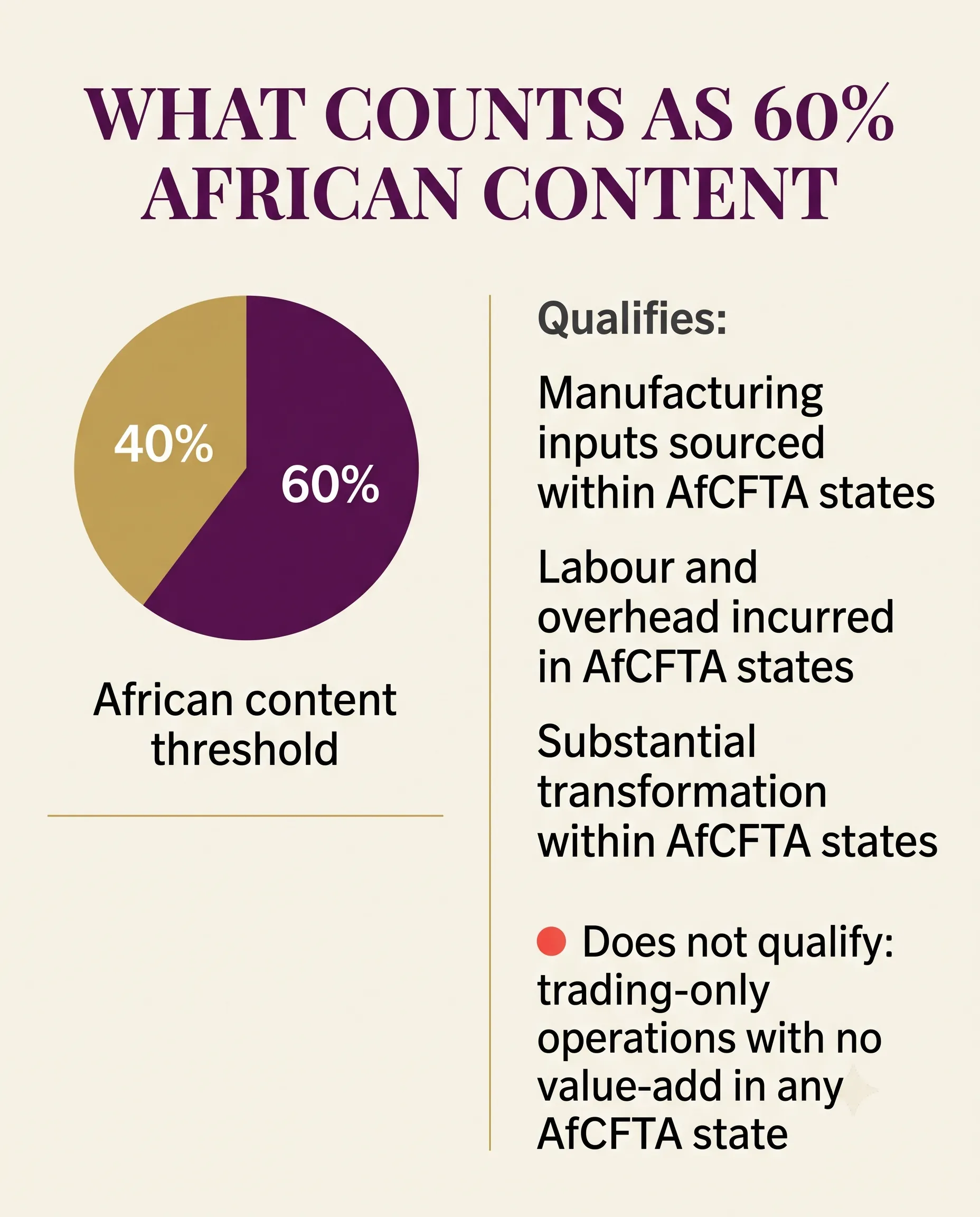
Under the value-add test, a manufactured good qualifies for AfCFTA preferential treatment if at least 60% of its ex-works value is added within African Union member states. The calculation requires the exporter to break down the cost structure: raw materials, labour, overhead, and profit margin — and demonstrate that the African-content portion is at least 60% of the total.
The test trips most first-time applicants in three predictable ways. The first is misclassification of inputs. Imported raw materials that are processed in Africa and re-exported under AfCFTA may not count toward the 60% threshold if the processing is minimal. A trader who imports finished fabric, cuts it in Africa, and exports the cut pieces as a manufactured good may find that the African value-add is closer to 20-30%, not 60%.
The second is documentation gaps. The 60% calculation must be supported by invoices, payroll records, and production logs. A trader who estimates the calculation without documentary evidence will fail the issuing authority's review.
The third is product-specific thresholds. Some product categories carry stricter or looser origin requirements than the general 60% rule. Apparel, for example, operates under a "yarn-forward" or "fabric-forward" rule depending on the specific AfCFTA protocol text. Vehicles and machinery have specific value-add calculations that differ from general manufactured goods. The exporter must identify the correct rule for the product before preparing the application.
The cost of failing the Rules of Origin test is not a fine — it is the lost tariff saving. The shipment arrives at destination, the certificate is rejected or invalidated, and the goods are assessed at the MFN rate. The exporter has paid the compliance cost without receiving the benefit.
How to Claim AfCFTA Tariff Treatment at the Border
The claim process at the destination border has three procedural requirements that must be met in sequence.
The first is the Customs Declaration. The importer or their customs broker files the standard import declaration with the destination customs authority. The declaration must include the AfCFTA preference claim, citing the relevant tariff line and the legal basis for the preferential rate.
The second is the Certificate of Origin presentation. The Certificate of Origin must be presented at the time of declaration or within the timeframe specified by the destination country's customs regulations. Most countries require the certificate at the time of declaration, with a short window (typically 30 days) for retroactive submission if the certificate was issued after the shipment departed.
The third is the supporting documentation. The destination customs may request the underlying evidence supporting the Certificate of Origin — production records, supplier invoices, and the application documentation. The importer should retain copies of all supporting documents for at least three years after the shipment, as post-clearance audits are common in the first year of AfCFTA implementation in many countries.
Failure at any of the three steps triggers a fallback to the MFN tariff. The customs authority does not unilaterally apply AfCFTA treatment — the importer must claim it, document it, and defend it.
Common Rejection Reasons and How to Avoid Them
Six rejection patterns appear in the first cohort of AfCFTA rejections across the implementing countries. Each is preventable.
The first is incorrect product classification. The exporter applies for a Certificate of Origin under one HS code, but the destination customs classifies the goods under a different code that is not on the destination country's tariff offer. The fix is to confirm the HS code with the destination customs authority before applying.
The second is missing Rules of Origin evidence. The Certificate of Origin application is submitted without the production records, supplier invoices, or value-add calculation. The fix is to compile the supporting evidence package before submitting the application.
The third is invalid issuing authority. The Certificate of Origin is issued by a body that is not the recognised AfCFTA issuing authority in the exporting country. The fix is to confirm the issuing authority on the AU AfCFTA Secretariat's country page before applying.
The fourth is expired or post-dated certificate. The Certificate of Origin has an expiry date (typically 6-12 months from issuance) or was issued after the shipment departed. The fix is to align the application and shipment dates so the certificate is valid at the time of presentation.
The fifth is shipment not covered by tariff offer. The destination country has not yet deposited a tariff offer for the product category. The fix is to check the destination country's tariff schedule on the AfCFTA Secretariat's database before assuming coverage.
The sixth is exporter not registered. The exporter has not completed the national AfCFTA registration process. The fix is to complete registration before applying for any per-shipment certificate.
When AfCFTA Is Not Worth the Paperwork
Three conditions suggest AfCFTA participation is not cost-effective for a specific shipment.
The first is low MFN tariff. If the destination country's MFN tariff is under 5%, the AfCFTA saving is too small to justify the compliance cost. The compliance cost — registration, application, documentary evidence, processing time — typically ranges from USD 200-800 per shipment depending on the country. For a USD 10,000 shipment at a 5% MFN rate, the saving is USD 500, which is offset by the compliance cost.
The second is product not on the destination's tariff offer. If the destination country has not liberalised the product category, AfCFTA participation provides no benefit regardless of the MFN rate.
The third is first-time trade with no prior relationship. The first AfCFTA shipment on a new corridor carries a higher rejection risk than subsequent shipments. The first shipment is also where the trader is least likely to have the supporting documentation in order. For a first-time trade, the conservative approach is to ship under the MFN rate, build the documentation template, and apply for AfCFTA on the second or third shipment.
Counter to the common assumption that AfCFTA participation is always worth it for African traders, the framework is a tool with specific operational costs. The cost-benefit calculation should be performed for each shipment, not assumed.
Country-Specific Notes (Kenya, Ghana, Nigeria, South Africa)
Kenya has been one of the most active AfCFTA participants. The AfCFTA Coordination Office is housed under the Ministry of Industrialisation, Trade and Enterprise Development, and the country has deposited a tariff offer covering approximately 90% of tariff lines. Kenyan exporters have been active in supplying manufactured goods, processed agricultural products, and pharmaceuticals to Ghana, Nigeria, and South Africa under AfCFTA preferential terms. For Kenyan importers sourcing from the continent, the most common corridors are South Africa (machinery, processed foods) and Egypt (chemicals, processed goods).
Ghana has ratified AfCFTA and operates the Ghana National AfCFTA Coordinating Office. Ghana's tariff offer is comprehensive and the country's port infrastructure at Tema makes it a natural entry point for West African trade. Ghanaian exporters have been active in cocoa products, processed foods, and garments to other ECOWAS states. For non-ECOWAS African states, Ghana's market is particularly accessible for AfCFTA shipments from East Africa.
Nigeria is the largest African economy and a critical AfCFTA market, but the country's tariff structure is complex. Nigeria's AfCFTA tariff offer is published and the country has operationalised the framework, but traders should expect detailed scrutiny of Certificates of Origin at Nigerian customs. For Nigerian importers, the most common AfCFTA corridors are Kenya, South Africa, and Egypt.
South Africa is the most industrialised African economy and a critical AfCFTA participant. South African Customs operates a digital Certificate of Origin system that integrates with the SARS (South African Revenue Service) platform. For South African exporters, AfCFTA shipments to Nigeria, Kenya, and Egypt have been the most active corridors. For South African importers, the most common AfCFTA corridors are Egypt (chemicals, processed goods) and Kenya (agricultural products).
The four-country notes above are operational starting points, not exhaustive coverage. The AU AfCFTA Secretariat's country page, updated quarterly, is the authoritative reference for current status.
A Note on What We Do
Rumali Supreme does not buy, sell, or take title to commodities — including gold, minerals, machinery, apparel, building materials, vehicles, and consumer goods. We facilitate cross-border transactions between buyers and vetted suppliers, charging a fixed facilitation fee for verification-only engagements and a percentage on successful transactions when our role extends to sourcing, payment coordination, or shipment oversight. Our reports, checklists, and blog content describe facilitation methodology only; they are not legal, tax, or financial advice, and should be read alongside current regulations in the jurisdictions involved.
Frequently Asked Questions
How does AfCFTA actually work for a small trader?
AfCFTA lets eligible goods move between participating African states at reduced or zero tariff, provided the goods meet the Rules of Origin. In practice the trader needs an AfCFTA Certificate of Origin issued by the national authority in the exporting country, documentation proving the origin-qualifying production, and customs declarations that claim AfCFTA treatment at the destination border. The paperwork is heavier the first time, but the tariff savings often justify the cost on the second and third shipment.
What is the AfCFTA certificate of origin procedure?
The exporter applies to the national AfCFTA coordination body, submits a commercial invoice, packing list, and production records proving the origin criteria, and the issuing authority generates the certificate. Approval typically takes 5-15 working days. The certificate is then presented to customs at the destination border alongside the standard import declaration.
Which products qualify for AfCFTA preferential tariffs?
Each participating country publishes a tariff offer listing the product categories it has liberalised. Manufactured goods with at least 60% African content generally qualify. Agricultural products follow specific Rules of Origin per product. Excluded products typically include arms, ammunition, and a small set of politically sensitive goods. The AU AfCFTA Secretariat's country pages list the active tariff offers.
Do I need to register to use AfCFTA?
Yes. The exporter or importer registers as a trader in the home country's AfCFTA coordination office. Registration is free or low-cost. Once registered, the trader can apply for Certificates of Origin for each shipment. Without registration, neither the exporter nor the importer can issue or claim AfCFTA treatment.
How long does AfCFTA tariff approval take?
From application submission to Certificate of Origin issuance, the process typically takes 5-15 working days, depending on the issuing country and product complexity. Destination customs clearance is then standard. Total lead time from application to cleared cargo: 2-4 weeks for most corridors.
What happens if my goods are denied AfCFTA treatment at the border?
The shipment falls back to the standard MFN tariff rate. The importer pays full duty. There is no automatic penalty beyond the lost tariff saving, but the incident may be flagged for future scrutiny. To avoid rejection, ensure the Certificate of Origin is correctly completed, the HS code matches the destination's tariff offer, and the Rules of Origin evidence is retained in case of post-clearance audit.
Related Articles

What 73% of Canton Fair Buyers Miss in the First 48 Hours (2026 Checklist)
Autumn 2026 Canton Fair runs 15 Oct–4 Nov. Most orders placed on first contact fail within 90 days. Ten pre-flight checks — plus three red flags that should stop any wire before you fly home.
The 5-Minute Trick That Catches 9 Out of 10 Fraudulent Freight Forwarders
A Mombasa buyer lost $38,000 to a fake freight forwarder in 96 hours. Don't be next. Seven verification checks — licensing, bonding, references — and the one red flag that ends the deal.

The 4 Decisions Every Diaspora Buyer Gets Wrong on Their First China Order
Over $50B in remittances flows to Africa annually — but first-time diaspora importers lose their capital on bad suppliers, wrong specs, and unverified freight. Five steps to source from China without becoming a statistic.

The 3 LC Discrepancies That Cost African Buyers $50K+ Per Shipment
65-75% of documentary credit presentations are flagged for discrepancies on first review. The three highest-frequency failure points, how to fix each one, and when an LC is the wrong instrument entirely.
Don't Learn About a Scam After You've Wired the Money
One short email per week. Real trade risk intelligence — supplier red flags, regulatory changes, and verification checklists. Before the wire, not after the loss.